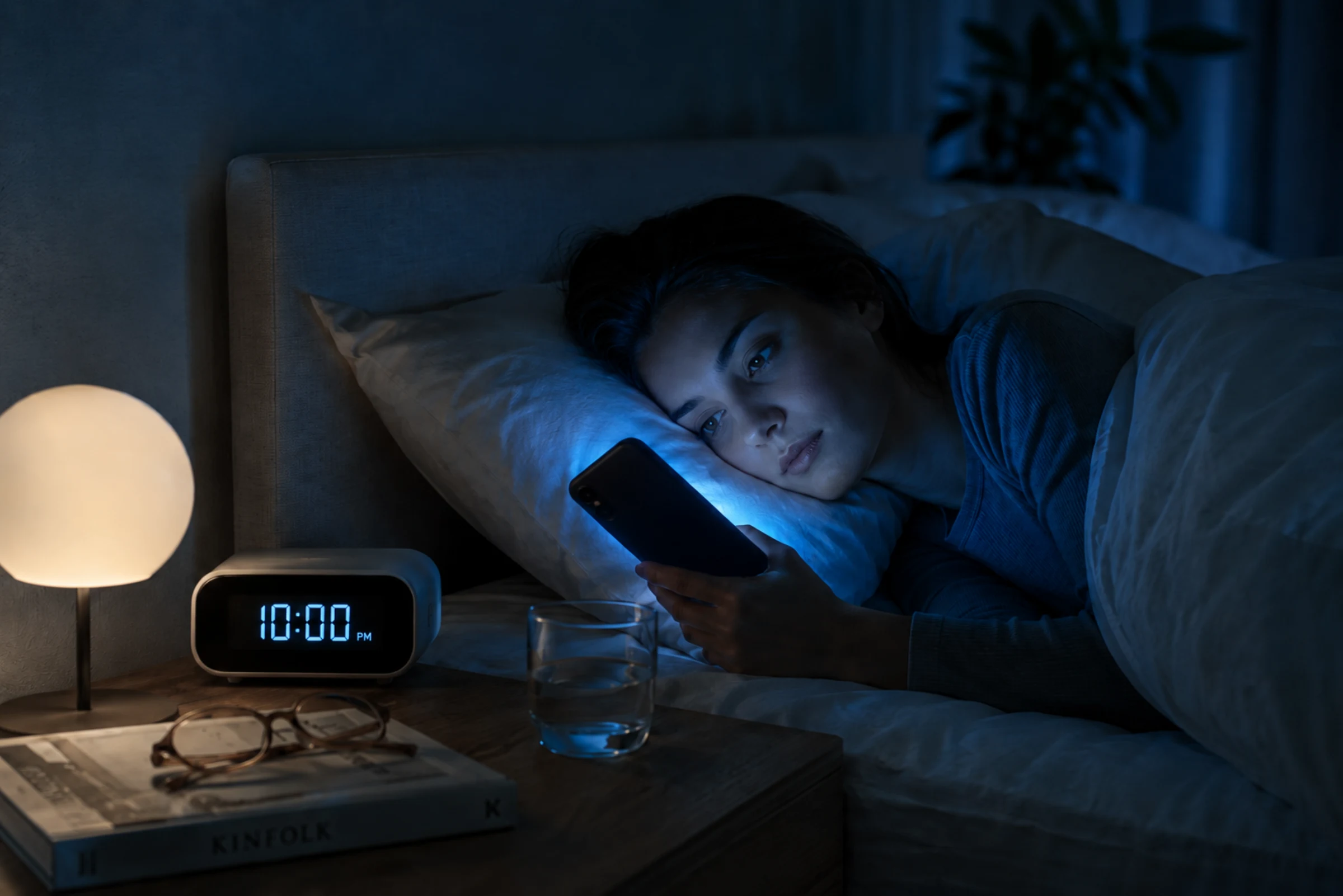
The chemistry of being awake is straightforward. In the morning, daylight hits the retina, the body releases cortisol, and a switch flips. You are alert, your temperature climbs, your appetite returns. In the evening, in the absence of bright light, the pineal gland releases melatonin, your core temperature drops, and you become drowsy on schedule.
This system runs on light, and runs almost entirely on the blue end of the spectrum. Wavelengths around four hundred and sixty to four hundred and ninety nanometres are the strongest signal to the suprachiasmatic nucleus — the cluster of cells that drives the circadian clock.
In daylight, that’s how it should be. Sunlight is rich in blue at midday and drops toward warmer wavelengths at sunset. The body evolved against that exact gradient.
The problem is what we put in the ceiling.
What colour temperature means
Artificial light sources have a colour temperature, measured in kelvin (K). Lower numbers are warmer; higher numbers are bluer.
- 2200K — candle flame
- 2700K — warm white incandescent feel, evening living-room
- 3000K — slightly cooler warm white, common in residential
- 4000K — “neutral” white, common in commercial spaces and kitchens
- 5000–6500K — “daylight” white, office, retail, medical
The problem isn’t that 4000K and 5000K bulbs exist. They have legitimate daytime uses. The problem is when they’re in the kitchen where you stand for forty-five minutes at 9pm.
What the research says
Harvard Medical School and others have documented that exposure to blue-rich light in the evening:
- Suppresses melatonin secretion (the sleep hormone) by a significant fraction, with the largest effects from short, intense exposures close to bedtime
- Shifts the circadian phase later, so falling asleep itself moves later
- Reduces sleep quality even when sleep duration is the same
This is not fringe research. The American Medical Association issued formal guidance in 2016 cautioning against overuse of high-correlated-colour-temperature (blue-rich) lighting at night.
Directional, based on published melatonin-suppression research. Actual values depend on intensity, duration, time of evening, and individual sensitivity.
A room planned for evening
The point isn’t to live by candlelight. The point is to give the body the same gradient it evolved against — brighter and cooler by day, dimmer and warmer at night — instead of flipping the gradient on its head every evening.
Three moves do most of the work.
Pick the right base temperature. For living areas, bedrooms, corridors, dining rooms: 2700K is the default. 3000K only if the room reads cold to the client. Anything 4000K and above should be limited to the kitchen, laundry, and bathrooms — rooms where you want clarity for tasks rather than mood.
Dim everything. Every fixture in a living space should be on a dimmer. The change in intensity matters as much as the change in colour: a warm light at 100% can still suppress melatonin if it’s bright enough. A planned evening setting is 10–20% of full brightness.
Layer the light. A single overhead is an evening problem; even at 2700K, it pushes light from above into the visual field. Instead: low fixtures (table lamps, floor lamps, sconces, picture lights) at eye level or below. Reading-light and ambient-light, on separate switches. Casa de la Luz uses this layering across three rooms.
What I specify
- Residential ambient: 2700K, dimmable LED, CRI 90+ (colour rendering matters — cheap LEDs make food look grey)
- Kitchen task: 3000K under-cabinet plus a 2700K pendant on a separate dimmer, so the kitchen can be a kitchen at dinner and a quiet zone after
- Bathroom: 3000K with the mirror on its own circuit, so you can find your toothbrush at midnight without lighting the room
- Bedroom: nothing overhead. Bedside lamps only, 2700K, dimmable. A reading book at 200 lux at the page; the rest of the room dark
- Smart bulbs are an acceptable shortcut for rented spaces where you can’t rewire. They’re a workaround, not the right answer; they fail when their app fails
The screen problem
A phone or laptop close to the face is brighter at the eye than most household ceilings. Night-mode shifts in the operating system help; they don’t fully fix the problem. The honest fix is to put the phone in another room at 9pm.
No one wants to hear that. Including me. But of all the design moves in this article, that’s the one that does the most.
The room knows what time it is
A well-lit room at night doesn’t feel like a darker version of the same room at noon. It feels like a different room. Lower light from below, warmer colour, smaller pools. It’s closer to firelight than office light.
That’s not a stylistic preference. That’s the room agreeing with your body about what time it is.