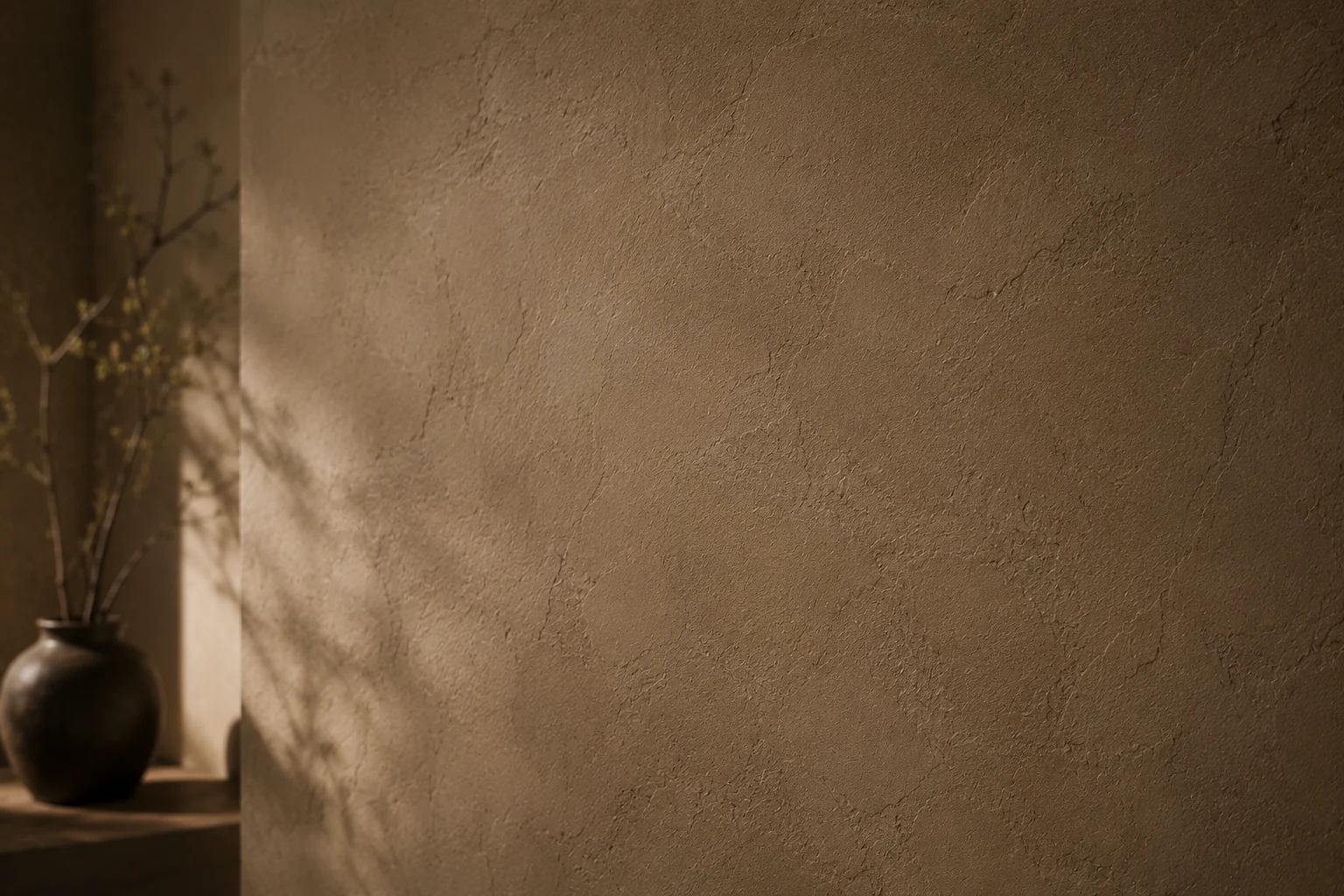
In the trade, “the walls” usually means painted drywall. Hang the sheetrock, tape, skim, prime, paint, and you have a wall. The system is fast and cheap and predictable. The wall is also, in material terms, mostly inert; once it’s up, it doesn’t do anything.
Clay plaster does things.
What it is
Clay plaster is made of three things: clay (the binder), sand (the structure), and a natural fibre — straw, cellulose, or hemp — for tensile strength. Sometimes a fourth: mineral pigment. It’s applied in two or three thin coats over a prepared substrate, each coat troweled with a steel float.
It’s one of the oldest wall finishes humans use. The earth-plastered walls at Çatalhöyük are about nine thousand years old. The same recipe, with regional variations, runs through North African, Iberian, Indian, and Southwest US architecture. Nothing about it is new. What’s new is that the recipe is now sold in bags, in branded colour palettes, with technical data sheets and warranties.
What it does that paint cannot
Painted drywall is essentially a closed surface. Paint exists to be cleanable, washable, stable; sealing the wall is the point. Clay plaster does the opposite: it stays vapor-open. Moisture moves through it in both directions. That single property changes how the wall behaves.
Humidity regulation. A clay-plastered room absorbs moisture from indoor air when humidity rises and releases it when humidity drops. Hygrothermal research from the Fraunhofer Institute for Building Physics and others has documented clay plasters buffering moisture at roughly thirty times the rate of conventional gypsum board. The practical effect is an indoor humidity that drifts gently toward fifty percent instead of swinging from twenty-five percent in winter to seventy-five in summer. For the occupants of the room, that’s the difference between cracked lips and stable comfort. For the building itself, less condensation on cold surfaces means less mould risk.
Indicative values, varying with thickness and clay composition. Sources: Fraunhofer IBP and earthen-architecture literature.
Antimicrobial behaviour. The high pH of moist clay (around nine to ten) is unfavourable to most mould and bacteria. This isn’t a marketing claim added by a brand; it’s a chemistry property the material has had since the Neolithic.
Acoustic absorption. A clay-plastered wall absorbs more sound than a hard-painted gypsum wall. The texture matters; troweled clay isn’t perfectly flat the way rolled latex is. Rooms feel quieter in a way that’s hard to describe in writing and obvious the moment you walk in.
Why it lasts
The strongest argument for clay plaster isn’t that it’s natural. It’s that it doesn’t need to be replaced.
A painted wall, no matter how well painted, accumulates scuffs, chips, drips, and stains. After five to eight years in any room that gets used, the only honest move is to repaint. The previous coat goes on top, and after enough cycles, the wall is millimetres of dried latex laminated to gypsum — a non-recyclable composite that ends in a landfill the next time the room is renovated.
A clay-plastered wall doesn’t accumulate paint coats. A scratch or chip is repaired by misting the area with water and feathering in fresh clay; the repair becomes invisible within an hour. The wall stays the wall. There is no recoat schedule. At end of life — twenty, thirty, fifty years on — the plaster can be re-wetted, removed, and either reused or composted. Nothing about it is hazardous waste.
The honest trade-offs
Three real ones.
Cost. A clay-plastered wall, materials and labour, runs roughly three to five times the cost of painted drywall. The crossover point — the year life-cycle cost beats paint — falls around the second repaint cycle. By year fifteen, clay is cheaper. But the upfront cheque is bigger, and that’s the first number a client sees.
Labour. Clay plaster requires a skilled trowel; a generalist drywall painter can’t do it well. The supply of trained applicators is thinner than the supply of painters, especially outside major cities. On every project I budget for the right hands; the wrong applicator turns a good material into a bad wall.
Drying time. A clay-plastered wall takes two to three days to dry between coats and a week to cure fully. That’s not paint-time. Schedule the trade earlier in the programme; don’t compress it.
What I specify
In my own work, clay plaster is the default in the rooms where people actually live — bedrooms, living rooms, dining rooms, primary corridors. Kitchens and bathrooms get a tougher finish (lime plaster, or a low-VOC washable paint, depending on the project) because clay isn’t a wet-area material. Stairwells and back-of-house corridors get whatever’s most efficient for the brief.
The brands I’ll spec have three things in common: a transparent ingredient list, a real pigment palette (not just an off-white range), and a technical team who’ll answer a substrate question on the phone. If a sales rep can’t tell you which primer to use without checking, the product isn’t ready for spec. The names worth knowing include American Clay, Clayworks, and TERMO, which I used on the upper floor of the firehouse residence.
A note on the texture
Clay plaster doesn’t read as paint reads. It has depth — a slight unevenness in the surface that catches raking light at the end of the day. People who’ve never seen it sometimes read this as a flaw. It isn’t. The wall looks like a wall made of earth, because it is.
After a few months of living with it, painted drywall starts to read as the strange thing — too flat, too uniform, too perfectly the same colour in every light. That’s the comparison clay plaster wins. Not on price, not on speed, but on what it’s like to be in the room.