The textile industry is the third-largest consumer of water globally and one of the largest sources of microplastic pollution in waterways. Most of that footprint sits inside two crops: cotton (water-intensive, often pesticide-heavy) and polyester (petroleum-derived, sheds microplastic with every wash). The honest interior-textile spec begins by reducing the share of those two and shifting to fibres that don’t carry the same ledger.
Linen and hemp do most of that work. They are also, in many applications, simply better fabrics.
What they are
Linen is the fibre of the flax plant (Linum usitatissimum), spun and woven the same way for at least seven thousand years. Pieces of woven flax have been recovered from prehistoric sites in Georgia (the country) and Egyptian tombs. Most commercial linen today is grown in northern France, Belgium, and the Netherlands — the climate is right; the supply chain is European.
Hemp is the long bast fibre of Cannabis sativa grown for fibre (not for the psychoactive part of the plant). It produces a similar fabric to linen but coarser, more durable, slightly stiffer. Hemp cultivation is legal across most of Europe and is rapidly returning to the US after a federal change in 2018.
Both fibres come from the stem of the plant, not the seed-bearing part. Both are processed by retting (controlled rotting that releases the fibre from the woody core), spinning, and weaving — mechanical steps that don’t require petrochemical solvents.
The water ledger
According to industry data summarised by the CABI agricultural research network and the European Confederation of Flax and Hemp (CELC):
- Cotton requires roughly 7,000–10,000 litres of water per kilogram of finished fabric (with regional variation)
- Linen requires roughly 6–10 litres per kilogram for the European flax crop, which is grown almost entirely on rainfall without supplemental irrigation
- Hemp is similar to linen, with most cultivation also rain-fed
The order-of-magnitude difference in water use is the single largest factor in why these fibres are environmentally cleaner. Cotton can be grown organically and rain-fed (Indian organic cotton, for instance), but conventional cotton remains a high-water-stress crop.
What they do, as fabrics
Breathability. Flax and hemp fibres are hollow at the microscopic level, which means they wick moisture away from the skin and dry quickly. Linen sheets are cool in summer because of this property, not because of any treatment. Hemp behaves similarly.
Strength. Both fibres are unusually strong — linen tensile strength is comparable to silk; hemp is significantly stronger, which is why ship rigging and sailcloth were historically hemp before nylon replaced them. The strength translates to long service life in upholstery and bedding.
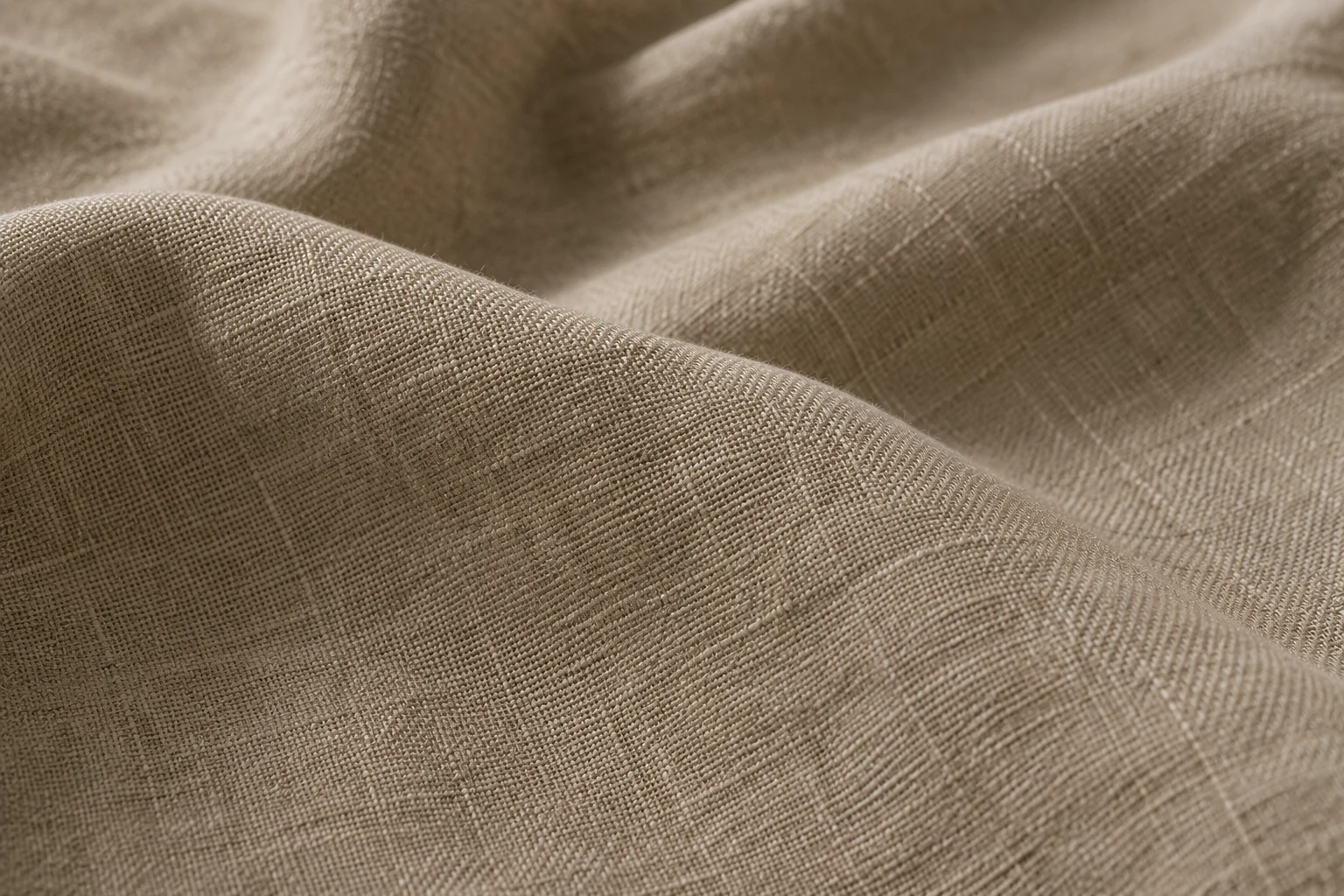
Texture. Linen has a characteristic slubby, slightly irregular weave that improves over years of washing. Hemp starts coarser, softens dramatically with use. Both fabrics age forward — they look better at year ten than year one.
Naturally antimicrobial. Both fibres resist mould and bacterial growth without chemical treatment.
Where the cleanliness gets diluted
Three places where a linen or hemp product can lose its sustainability advantage.
Bleaching and dyeing. The fibre itself is clean. The whitening and colouring steps can use chlorine-based or heavy-metal-laden chemistry. OEKO-TEX Standard 100 certification on the finished product addresses this — it caps the residual chemistry on what reaches your skin.
Finishes. “Wrinkle-free,” “easy-care,” and “stain-resistant” treatments on linen and hemp typically use formaldehyde-based resins or PFAS chemistry. Skip these finishes; choose unfinished or hard-finished only.
Blends. “Linen-blend” sheets are usually mostly polyester. Read the composition label. 100% linen, 100% hemp, or a stated blend with another natural fibre (cotton, wool) is fine; 30% linen / 70% polyester is a polyester product with linen marketing.
Where I use them
- Bedding. 100% linen sheets and pillowcases. Coarser hemp blend in mid-priced ranges. Both age into the fabric people remember from their grandmother’s linen press
- Curtains. Linen drapery has natural body and light-filtering quality. A heavier lined linen for sound-absorption work; a sheer linen for filtered daylight
- Upholstery. Hemp canvas for high-wear seating (sofas, armchairs in living spaces); washed linen for low-traffic pieces (bedroom chairs, headboards)
- Tea towels, table linens, hand towels. Linen is the better material than terry cotton for hand and tea towels — absorbent, dries fast, lasts longer, looks better hung over a rail
What I specify
- European flax (European Flax® or Masters of Linen® certification, both run by CELC) for the supply-chain provenance — rules out the long-haul imports that account for most of linen’s embodied carbon
- OEKO-TEX Standard 100 certification on dyed or printed finished fabric
- GOTS (Global Organic Textile Standard) where the fibre is organically grown
- No wrinkle-free, no easy-care, no PFAS-treated, no Scotchgard. The fabric is meant to wrinkle
- For upholstery requiring stain protection, a hemp canvas with no chemical treatment plus a removable, washable cover. The cover is the stain protection
The slow fabric
Linen and hemp don’t look like new fabric for long. They wrinkle when you sit on them; they soften with washing; they fade subtly in sunlight; they develop a hand that someone unfamiliar with the material will read as “worn.” That reading is wrong. The wear is the point.
In a culture that mostly buys textiles to be replaced, choosing fabrics designed to be kept is one of the quieter sustainability moves. The fibre was grown without irrigation, the dye is bounded by standard, the wash makes it better. Then you live with it for fifteen years.