Have you ever walked into a freshly painted room and felt a headache start to build? That’s the room talking to you. The smell is volatile organic compounds — VOCs — gassing out of the paint. The headache is your body objecting.
Most people open a window, wait a few hours, and forget about it. The problem is that after the smell fades, the off-gassing doesn’t. Modern paints, adhesives, sealants, and finishes keep releasing chemicals for months and years after they’re installed. The room is still talking. Just quietly.
What the science says about your body
The EPA’s definition of VOCs is broad: a long list of carbon-based chemicals that evaporate at room temperature. Formaldehyde, benzene, toluene are the ones that show up most often in interior building products. Published health effects start at irritation — headaches, fatigue, watery eyes, sore throats — and run all the way to long-term damage of the respiratory and central nervous systems. Some VOCs are classified carcinogens.
The kicker is concentration. EPA data shows VOC levels indoors run up to ten times higher than outside, and that’s an average. In a newly renovated, poorly ventilated room, the multiplier is higher.
EPA, on indoor air quality in residential buildings.
Most of us spend more than ninety percent of our time inside. The children, pregnant women, and asthmatics in those rooms are the most exposed.
Picture a nursery painted the week before the baby arrives, with peel-and-stick wallpaper on one wall and new carpet on the floor. Three building products, all off-gassing into the same eight-foot-by-ten-foot box, into the lungs of a six-month-old. That’s the worst version. Mild versions of the same picture are in nearly every home that’s been renovated in the last five years.
It’s not only physical health. A widely cited 2015 Harvard study put office workers in identical rooms with three different ventilation and material profiles — conventional, “green,” and “green+” with better ventilation and lower-VOC products. The participants didn’t know which room they were in. Their cognitive scores did.
Twenty-four participants tested in three building conditions; biggest gains in crisis response, strategy, and information usage.
The study was about offices, but the takeaway transfers cleanly to homes. Cleaner air doesn’t just stop the headache. It also lets you think.
Why this is also a planet problem
VOCs don’t stay inside. Once they vent, they react with sunlight and nitrogen oxides from cars and factories to form ground-level ozone — the brown haze that hangs over Los Angeles on a still summer afternoon. Conventional finishes also rely on fossil fuels at every step: extraction, manufacture, transport, end of life. Petroleum-based products generally can’t be recycled, and many are classified as hazardous waste. A tin of old vinyl floor adhesive in a landfill is still off-gassing decades later.
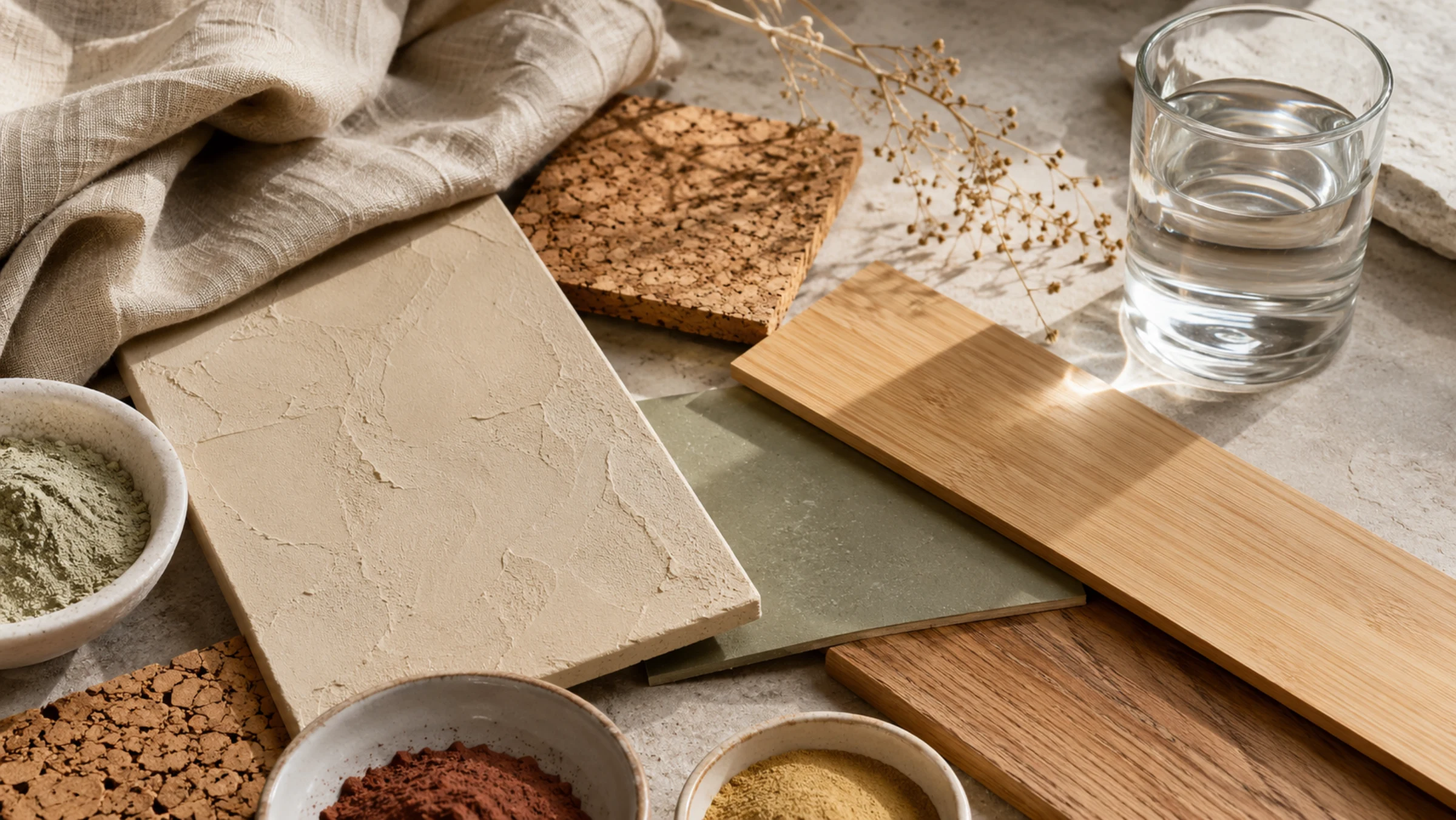
The alternatives are not exotic. Water-based, low-VOC paints. Natural linoleum — linseed oil, cork or wood flour, jute backing. Cork. Bamboo. Clay plasters. A 2020 peer-reviewed comparison of biobased and conventional materials concluded plainly that biobased can be “an environmentally friendly solution for reducing the total indoor and outdoor impacts on human health.” Trees absorb carbon as they grow, and a fraction of that carbon stays locked inside the timber for the building’s life. So a wood or cork floor is, modestly, a carbon store.
A reasonable skepticism is that not every biobased material is automatically virtuous. Bamboo from a cleared rainforest, or wood from a poorly managed plantation, can be worse than the conventional product it replaces. This is what Forest Stewardship Council certification exists for. Programs like LEED and the Living Building Challenge only award credits when wood, cork, or bamboo carry responsible-sourcing labels and meet emissions limits. Third-party Environmental Product Declarations describe a product’s footprint across its entire life cycle, extraction through disposal. The point of those acronyms is to give a designer or homeowner a way to verify the claim before they buy.
Cost, durability, awareness
If healthier alternatives exist and the planet would prefer them, why aren’t they the default? Three reasons, usually.
Cost. Green materials run more upfront than the conventional version. Most residential projects are financed against monthly payments and pay-back horizons measured in months, not decades, so even a small premium gets cut. The life-cycle math — lower energy bills, fewer asthma flare-ups — is sound, but it doesn’t show up on a loan estimate.
Durability. This used to be the strongest objection; first-generation low-VOC paints did chalk and yellow. Then the formulations improved. A recent industry review found that modern sustainable coatings using nanotechnology or self-healing chemistry “can equal or surpass the longevity of conventional coatings,” with self-repairing surfaces reducing the need for recoating (Malik and Sarkhel, 2024). The durability gap is closing every year.
Awareness. Public concern is moving. The Harvard Joint Center for Housing Studies reported that thirty percent of US households named some aspect of their home as a health concern in 2018, up three points from 2014, with indoor air quality leading the list. Thirty percent isn’t a majority. It’s also millions of projects.
What I specify
In my own work, the default is water-based low-VOC paint, full stop. The Greenguard Gold or equivalent label has to be on the can; if it isn’t, the can doesn’t get specified. The same logic runs through the finishes schedule:
- For wood, I look for FSC certification on the tech sheet. If it isn’t there, I ask the rep. If the rep doesn’t know, I move on.
- Carpet glues, sealants, and caulks are the sneaky ones — easy to overlook, full of solvents. I keep a short list of pre-approved adhesives so I don’t have to re-research every project.
- When formaldehyde appears anywhere on a furniture data sheet (most often in pressed-wood substrates), the piece doesn’t make the FF&E list. There are alternatives in nearly every category now.
None of this is dramatic. It’s slow, line-by-line specifying. But the difference between a room you can move into on day one and a room you have to ventilate for a fortnight comes down to those line items.
The room is still talking
Low-VOC and biobased materials won’t save the planet on their own. They won’t even save the renovation that uses them; the rest of the project still has to do its work. But they make one room less of a slow chemical leak, and they trade a small upfront premium for a quieter set of long-term costs — to the occupant, to the air outside, to the systems that have to clean up the next forty years of construction waste.
Next time you walk into a freshly painted room and your eyes water, that’s information. Open the window. Then ask what’s on the wall.