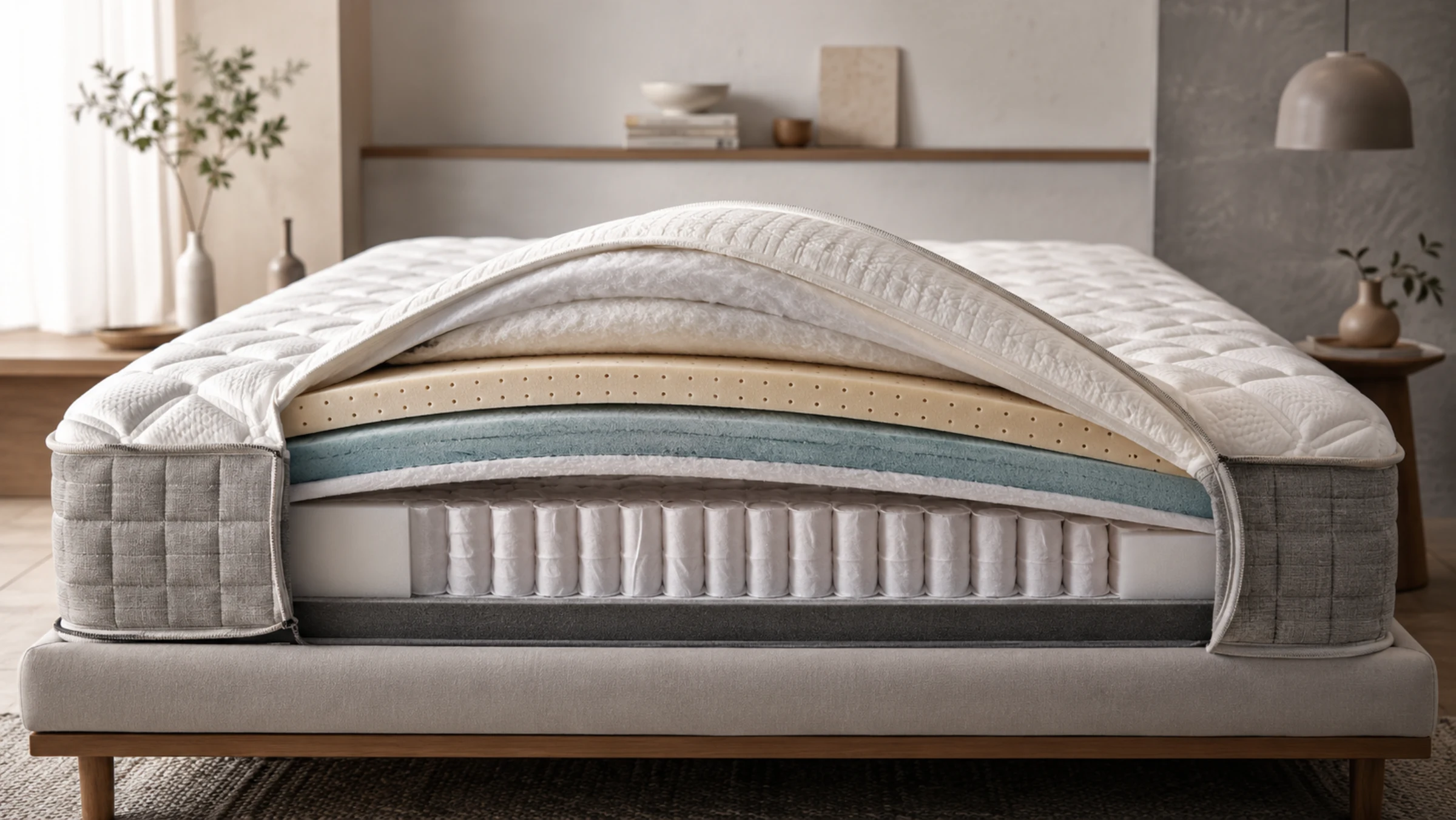
The mattress is the largest object in your bedroom. You spend roughly a third of your life with your face pressed against it. By volume and by hours of contact, nothing else in the house is as close to your body for as long.
It is also, in a conventional construction, one of the most chemically complex items most people own.
What a conventional mattress is
Open the average mattress sold today and you find a small chemical assembly:
- A core of polyurethane (PU) foam, petroleum-derived, sometimes with memory-foam layers
- A polyester quilt layer on top, frequently synthetic-blend batting
- A vinyl moisture barrier in many designs
- A fire-retardant treatment — historically PBDEs, now usually chlorinated organophosphate retardants such as TDCPP and TCPP
- Adhesives binding the layers together, often solvent-based
In an industry-standard mattress, the only natural material in the construction is the cotton on the ticking. And even that is usually a polyester-cotton blend.
The flame-retardant story
Until 2013, California’s TB117 standard effectively required mattresses sold in the US to resist a small open flame. Manufacturers met that test, easily and cheaply, by adding chemical flame retardants to the foam. Two classes dominated.
PBDEs (polybrominated diphenyl ethers) were banned in many uses by the early 2000s and 2010s after research associated them with thyroid disruption and neurodevelopmental effects in children. They were detected in essentially every American sampled and in breast milk worldwide. CDC biomonitoring data documented some of the highest body burdens globally.
TDCPP and TCPP (chlorinated tris) replaced PBDEs and are themselves listed by California’s Proposition 65 as substances known to the state to cause cancer.
The 2013 revision of TB117 allowed manufacturers to meet flammability standards without chemical treatments. Many still use them — they’re cheap, they read as safety, and there is no legal requirement to disclose. Unless a mattress is independently certified flame-retardant-free, you have no way to know.
What we actually know about exposure
You don’t need to inhale the foam directly. These compounds migrate into house dust, settle on sheets, and contact skin throughout the night. Research from Duke University and others has found:
- Detectable flame-retardant metabolites in the urine of nearly all sampled individuals
- Higher concentrations in young children, who spend more time on the floor and in beds, and who weigh less per dose
- Hand-to-mouth pathways for toddlers, who roll on mattresses and put fingers in their mouths
These are exposure findings, not yet causal proof of harm at the doses most people encounter. The honest scientific position is that long-term, low-dose exposure to multiple of these compounds remains poorly studied, and the burden of proof has historically fallen on regulators rather than manufacturers.
What a cleaner mattress is made of
The healthy version is short: natural latex, wool, organic cotton.
Natural latex — from rubber trees. Supportive, durable, no chemical foam. Look for GOLS (Global Organic Latex Standard) certification, which excludes synthetic blends and verifies the supply chain. “Natural latex blend” usually isn’t.
Wool — naturally flame-resistant without chemical treatment, moisture-wicking, antimicrobial. Replaces synthetic batting and chemical retardants in a single move.
Organic cotton — for ticking and quilt layers. Look for GOTS (Global Organic Textile Standard), which controls pesticide use in cultivation and chemistry in processing. “Organic cotton” without GOTS is a marketing word.
A well-built natural mattress lasts fifteen to twenty years; the PU-foam equivalent is typically replaced every seven to ten. Across a thirty-year span the natural version is usually cheaper, even before considering whatever you place on the “a third of your life against my skin” side of the ledger.
What I specify
For residential projects I treat the mattress as a finish item and write it into the FF&E schedule rather than leaving the client to figure out alone the night before move-in. The rules:
- Natural latex core, GOLS-certified — or a solid hardwood platform with a thick wool topper for clients who prefer firmer feel
- Wool barrier instead of chemical flame retardant. The tech sheet has to say so explicitly
- GOTS-certified cotton ticking. “Organic” alone isn’t a certification
- No vinyl. No memory foam. No CertiPUR-US as the sole certification — that’s industry self-cert and certifies a narrower set than its name suggests
Brands worth knowing without endorsement include Avocado (US), Naturepedic (US), Coco-Mat (EU), Naturalmat (UK). I’m not affiliated; these are simply the ones whose tech sheets I trust on first read.
A note on the second-hand bedframe
A natural mattress isn’t cheap. A clean alternative for a guest room or starter setup is a second-hand bed frame paired with a new natural mattress, rather than new everything. The frame is mostly inert wood and metal; the mattress is where the chemistry sleeps.
The wall of your sleep
You can’t completely eliminate exposure to industrial chemistry. You can, very rationally, take it out of the one surface against which you spend a third of your life.
Open the window. Then ask what’s under the sheet.