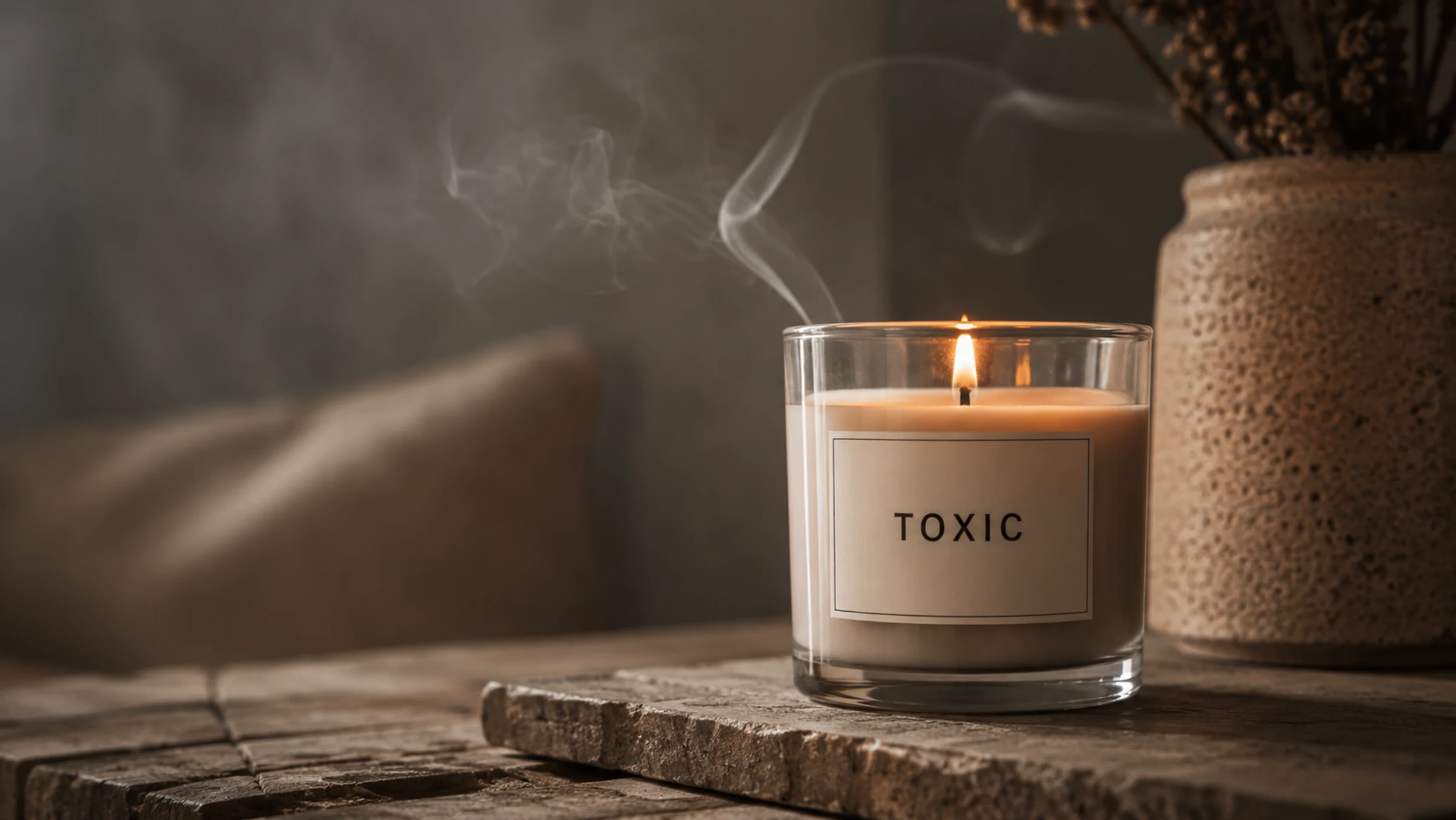
When the news talks about air pollution, the pictures are always outdoors — the brown smog over a city, the freeway at rush hour. The data does not match the pictures.
For most people in most homes, the highest particulate exposure of the day happens inside. The kitchen is the worst room, by a meaningful margin.
What PM2.5 is
PM2.5 is particulate matter smaller than 2.5 micrometres across — about one-thirtieth the diameter of a human hair. It’s small enough to bypass the body’s upper-respiratory defences, lodge in lung alveoli, and pass into the bloodstream. Long-term exposure is robustly associated with cardiovascular disease, respiratory illness, and reduced cognitive performance. The WHO classifies outdoor particulate matter as a Group 1 carcinogen.
The current WHO air-quality guideline for PM2.5 is an annual mean of 5 µg/m³ and a 24-hour mean of 15 µg/m³. These are protective targets. They are also routinely exceeded indoors.
Where indoor PM2.5 comes from
Five sources, in rough order of how often they dominate a home:
Cooking. The single largest source in most kitchens. Frying generates the highest particulate loads, followed by sauteing, grilling, and toasting. Even boiling a pot of water releases particles, just fewer of them. The WHO and EPA both identify cooking as a primary indoor source.
Gas stoves. Combustion adds nitrogen dioxide (NO2) and ultrafine particles to whatever the cooking itself is producing. A growing body of research, including from WHO indoor air guidelines, associates gas-stove use with elevated childhood asthma risk in homes with inadequate ventilation.
Candles, incense, and fragrance diffusers. Combustion candles release soot directly into the breathing zone. Scented candles add fragrance VOCs (limonene, formaldehyde precursors). Incense produces particularly high particulate output per stick.
Wood-burning fireplaces and stoves. Even when sealed and well-vented, they leak some particulate. An open hearth fire in a living room is, in pollution terms, equivalent to running a small bonfire indoors.
Laser printers, vacuums without HEPA, and forced-air heating with dirty filters. All produce or re-suspend particles. Less consequential than the first three, but worth knowing.
The range hood is a health item
A range hood is the single most important PM2.5 intervention in a residential project, and it’s the one most consistently specified badly.
The rules:
- Ducted to outside, always. A recirculating hood — one that filters air and returns it to the room — cannot remove combustion products. It is a noise machine that captures grease. In a kitchen with no possible duct path, a high-quality carbon filter is the second-best option, not a replacement
- Sized to the burner load. Roughly 300 m³/h for a four-burner gas hob, more for higher output. The hood must cover the full burner footprint, not float decoratively in the middle
- Used every time. Standard practice in many homes is to switch the hood on for stir-frying and skip it for boiling pasta. The pasta steam alone is fine; the burner residue underneath is not
- Run it for ten minutes after the cook ends. Particles linger; ventilation continues working after the burner is off
The induction question
Switching from gas to induction removes the combustion source. The food still produces particulate — oil, char, smoke — but the NO2 goes to zero and the ultrafine-particle load drops substantially. Induction is also faster, cooler in the room, and more energy efficient than gas at the appliance.
For new and renovated kitchens, induction is the default I recommend. Gas only when the client cooks at a professional level and understands the trade.
When a purifier helps
A good HEPA-grade air purifier reduces PM2.5 meaningfully, particularly during and after cooking. It is not a substitute for a range hood — the hood captures at source; the purifier processes what the hood missed. A pair works.
Two cautions:
- HEPA captures particles. It does not remove gases (VOCs, NO2); for that you need activated carbon
- Ionising and ozone-generating “air purifiers” should be avoided. Ozone is itself a respiratory irritant and a regulated pollutant outdoors. Several models marketed as “ionic” produce harmful ozone levels in normal use
What I specify
- Induction hob as default for new kitchens, unless the brief is specifically professional gas
- Ducted range hood, sized to the burner load, on a humidity-or-particulate-sensing switch where possible
- No combustion candles in client briefs that ask for fragrance. Cold diffusion with linen-bag herbs, or a non-flame option
- Sealed wood-burning stove with external air supply, not an open hearth, where the client wants fire
- HEPA + activated-carbon air purifier in any project with kitchen open to living, or asthma in the household. Run continuously at low speed in shoulder seasons; spike during cooking
- For older properties with forced-air HVAC: a MERV-13 filter at minimum, changed quarterly
The visible plume
The next time you fry an egg, leave the kitchen light on and watch the air move above the pan. The visible plume is the part you see; the PM2.5 is the part you don’t. Both are going somewhere, and without a hood, both are going to the rest of the apartment.
A duct, a fan, and ten extra minutes of run time after dinner. That’s most of the indoor-air problem in most homes, solved.