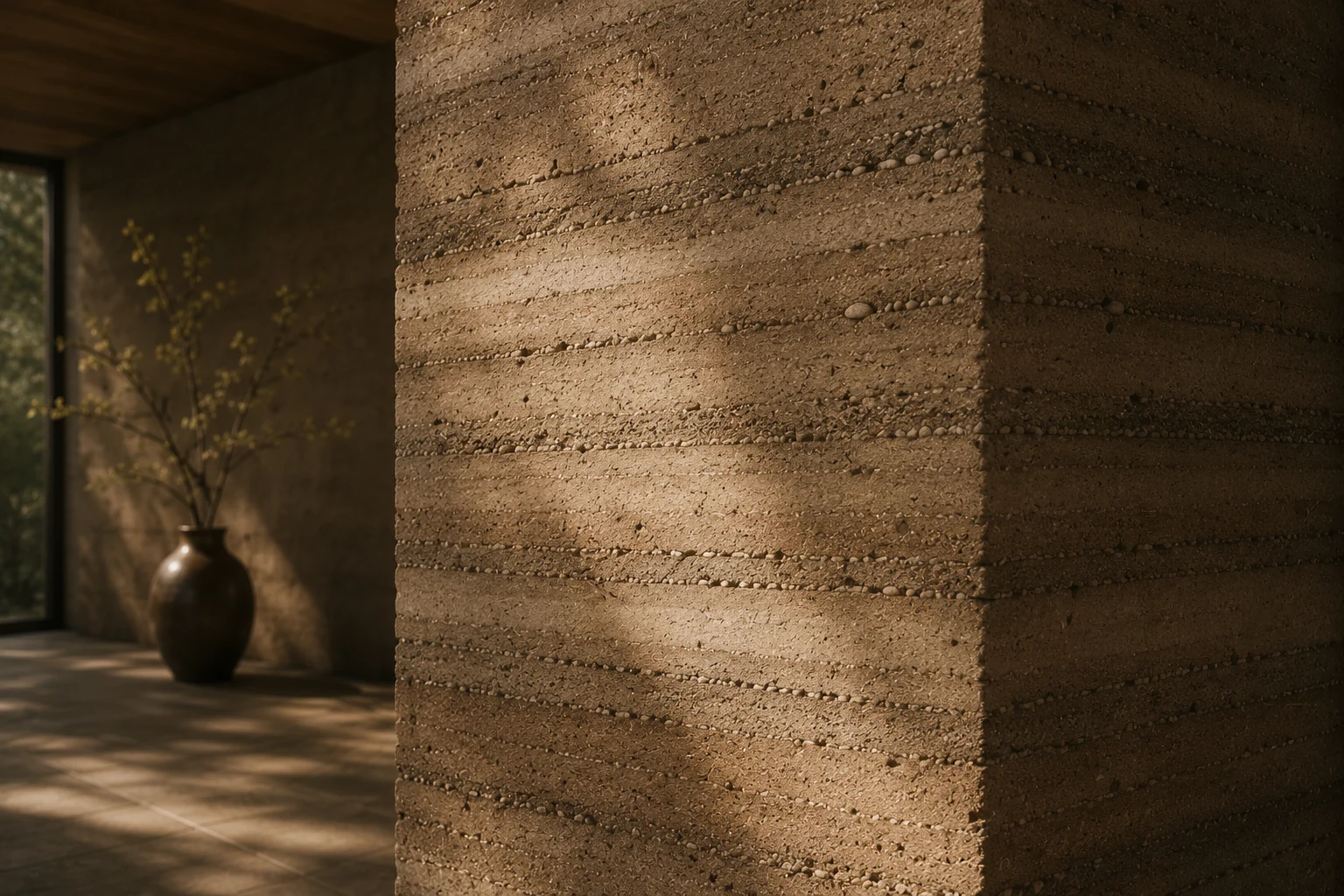
A rammed-earth wall is exactly what the name says: damp earth, compacted between formwork until it’s as dense and hard as soft sandstone. No firing, no chemistry, almost no embodied energy. Sections of the Great Wall of China are rammed earth. So are parts of the Alhambra. So is the Cordilleras Real of southern France. There are rammed-earth buildings still in service that were built before the Roman Empire ended.
It’s also one of the most thermally interesting wall systems available to a modern designer, which is why it’s having a slow, deliberate return in contemporary practice.
What it is
Rammed earth is built from a mix that’s roughly 70% subsoil (sand, silt, gravel, very little clay) and 30% binder. Traditional walls used clay as the binder; modern stabilised rammed earth uses a small percentage of natural hydraulic lime or, in some applications, a small percentage of cement. The mix is poured into formwork in layers of about ten to fifteen centimetres and compacted with a pneumatic or hand-rammer until each layer is bound to the one beneath. The formwork comes off after a few days; the wall continues to harden for months.
The visible result is a wall with horizontal striations — the soft lines of each compaction layer — in earth tones that come directly from the local subsoil. A rammed-earth wall in Provence is pale ochre. A rammed-earth wall in Western Australia is iron-red. The geology of the site appears in the finish.
What it does
High thermal mass. A 50-cm rammed-earth wall has enormous thermal inertia — it warms slowly during the day, releases heat slowly at night, and damps both the daily and seasonal temperature swings inside. In hot, dry climates with cool nights (Spain, southern France, Western Australia, parts of California) this is the property that’s most useful. It largely replaces the need for active cooling in summer and reduces heating loads in winter.
Humidity-buffering. Like clay and lime, rammed earth is vapour-open. Indoor humidity drifts toward 50% naturally because the wall absorbs and releases moisture in response to the air.
Naturally fire-resistant. A 30-cm rammed-earth wall has a fire-resistance rating measured in hours rather than minutes. It cannot burn.
Acoustically dense. The mass blocks airborne sound far better than gypsum-and-stud construction.
Low embodied carbon. The earth doesn’t need to be manufactured. The lime stabiliser involves some kiln energy. The cement-stabilised version (5–8% cement) has more embodied carbon than the pure version, but still substantially less than equivalent concrete or fired-brick construction.
The honest limitations
Rammed earth is not a default solution. Three real constraints.
Climate. Pure rammed earth is at its best in dry climates with significant daily temperature swing. In wet, cold climates, the thermal mass is less helpful, the wall needs external rain protection, and the construction window is narrower. It’s why Mediterranean and southwestern-US examples dominate the contemporary catalogue.
Trade availability. The number of contractors who do rammed earth well is small in most countries. The technique is recoverable — teams like Earth Structures Group in Australia and various practitioners in France, Spain, and the US Southwest have published methods — but for a typical residential project, getting a qualified team in place is the first hurdle.
Wall thickness. A structural rammed-earth wall is 30–50 cm thick. That eats more floor plate than a comparable timber-and-insulation wall. In a small urban project the loss can be material.
Cost. Higher than conventional construction for a single wall in most markets, despite the input material being essentially free. The cost sits in labour and formwork.
Where it earns its place
Three programmes where rammed earth is a strong fit:
- A single, expressive structural wall in an otherwise conventionally-built house — usually the south-facing or back wall, where the thermal mass does its work and the aesthetic justifies the cost
- Whole-building rammed earth in rural projects in dry climates — new-build houses in Spain, Portugal, southern France, parts of the US Southwest, where the form matches both climate and regional architectural lineage
- Boundary walls, garden walls, retaining walls — lower technical bar than a structural building wall, no rain-protection issue if detailed correctly, beautiful at the boundary of a house
Two programmes where it’s the wrong call:
- Small urban infill, where the wall thickness and structural mass don’t pay for themselves
- Cold and wet northern European climates, where the thermal mass is less useful and the construction season is short
What I specify
- Hydraulic-lime stabilised mix rather than cement-stabilised, where the local soil allows. NHL 5 is the typical binder; 5–8% by volume is the typical proportion
- Locally-sourced subsoil — the colour and texture of the wall is the geology of the site. Trucking subsoil in defeats the embodied-carbon advantage
- An overhang or eave that protects the wall from direct rain. The historical detail (“a good hat and good boots”) still applies to contemporary rammed earth
- A specialist team with completed projects to inspect. The technique is recoverable but the gap between good and bad execution is large
- An inner ramming finish, left exposed. Plastering over rammed earth defeats the point
The slow wall
A rammed-earth wall is not a fast wall. It’s built layer by layer, by people working in formwork on site, in good weather, over weeks. The result is a wall that stays warm in winter, cool in summer, doesn’t off-gas anything, doesn’t need to be painted, and was made out of the ground it’s standing on.
It’s the opposite of fast architecture. That’s also a description of why it’s worth specifying when the project allows. The wall is older than concrete, and it will probably outlast it.