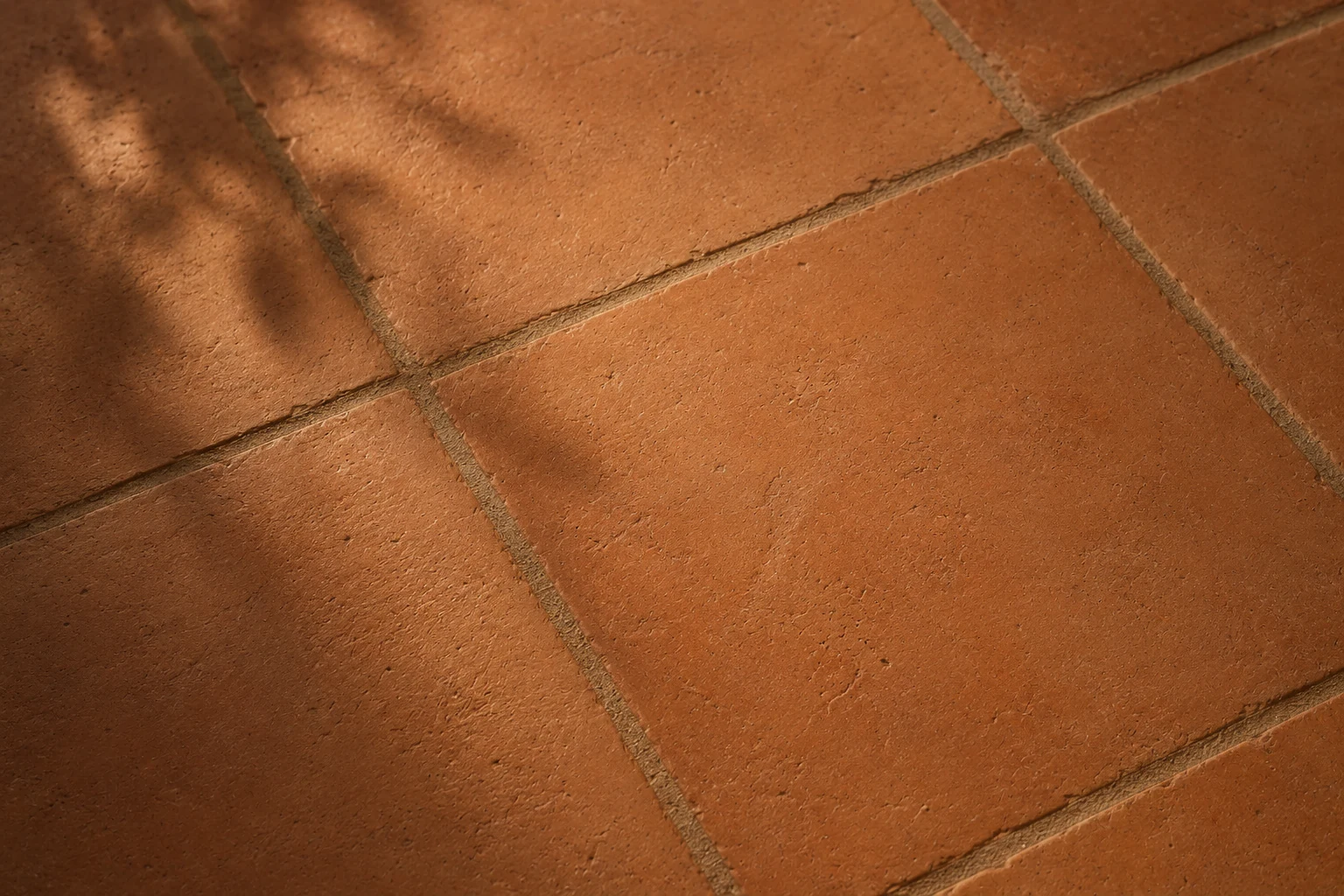
Stone and terracotta are the materials we used before we invented composites. They are heavy, expensive to transport, slow to install, and impossible to mass-produce without sacrificing the qualities that make them worth the effort. They’re also, when sourced locally and detailed correctly, two of the cleanest material decisions a project can make.
Most of the sustainability conversation in contemporary interiors is about replacing petroleum products with biological ones. Stone and terracotta are mineral, and that’s a different conversation — one about quarry footprint, transport carbon, longevity, and end of life.
What stone is, for our purposes
For interiors, the relevant stones are:
- Limestone — soft, warm, ages with use. Used for floors, fireplaces, walls. The default stone of Mediterranean architecture
- Travertine — a porous limestone formed in mineral springs. Visible “voids” from gas bubbles in the stone’s formation; characteristic of Roman architecture
- Marble — metamorphosed limestone, harder, takes a high polish. The classical statement stone
- Granite — igneous, extremely hard, low-maintenance. The kitchen-worktop default for half a century
- Slate — metamorphosed shale, splits in flat layers. Roofing, flooring, hearths
- Sandstone — sedimentary, warm to the eye, slightly more wear-prone
Within each of those categories, dozens of named varieties exist — Carrara, Calacatta, Bianco P, Pietra Serena, Indiana Limestone, Yorkshire Sandstone. Provenance matters.
The sustainability question for stone
Stone is the material whose embodied carbon is most dominated by transport. The quarrying itself, while energy-intensive, is moderate per kilogram. The shipping of a slab from Carrara to a New York apartment, by contrast, is significant. A study comparing local sandstone to imported granite for the same application will typically show the local material winning by an order of magnitude on lifecycle carbon, even when the imported material is the harder, lower-maintenance choice.
For the same reason, a Spanish project specifying Spanish limestone, an Italian project specifying Italian travertine, or a French project specifying French limestone is making a meaningfully different sustainability decision than the same project shipping in the same stone from a more famous quarry across the world.
Reclaimed stone — recovered from demolished buildings, restoration sites, or stone yards — is the cleanest end of the spectrum. The carbon was paid centuries ago.
Terracotta — the fired-earth alternative
Terracotta is clay shaped into tiles or blocks and fired at relatively low temperatures (around 950–1100°C, lower than porcelain). The lower firing temperature means lower embodied energy than porcelain or vitrified ceramic tiles. The clay is typically local; many regions have terracotta traditions tied to specific clay pits — Provence, Tuscany, Andalusia, Mexico, North Africa.
Terracotta’s relevant properties:
- Warmer underfoot than stone or porcelain. The clay retains less heat at ambient temperature; a terracotta floor in a sunlit room reads warmly even without underfloor heating
- Porous, breathable. Like other earth-based materials, terracotta participates in humidity regulation
- Ages well. Sealed with linseed oil or natural beeswax (no synthetic sealant), terracotta develops a patina over years that no replicated material can mimic
- Lower carbon than porcelain. The shorter, cooler firing significantly reduces embodied energy compared to vitrified tile
- Imperfect by nature. Handmade terracotta has variation in shape, colour, surface finish. The variation is the character; it’s also what manufactured-pattern porcelain tries to replicate
Where the case turns negative
A few honest cautions.
Engineered stone (quartz worktops) is not stone. Caesarstone, Silestone, and similar products are 90% ground quartz bonded with petroleum-based resin. They’re marketed alongside real stone but are a different product chemically — closer to plastic with a stone aggregate than to stone. Workers cutting engineered quartz also face documented silicosis risk at a much higher rate than those cutting natural stone, which is its own ethical problem in the supply chain.
Stone sealants and finishes vary widely. Most stones need some surface treatment to resist staining. Penetrating sealers based on natural oils or modern fluoropolymer chemistry have very different indoor-air profiles. The honest spec asks the supplier what specifically is in the sealer; the right answer is a short list of named ingredients.
Imported “terracotta” tile that’s actually porcelain. The marketing word has stretched. Handmade terracotta has the irregularities of clay shaped by human hands. Machine-pressed porcelain in a terracotta-look is a different product. Both can work; the spec should distinguish them honestly.
What I specify
- Local stone first. Spanish limestone for Spanish projects, French limestone for French projects, regional quarries within a few hundred kilometres where possible
- Reclaimed stone for fireplaces, thresholds, hearths, accent walls. Better aged, better priced, lower carbon
- Handmade terracotta for kitchen and bathroom floors in warm-climate projects — from small regional producers rather than industrial tile factories
- No engineered quartz for worktops. Solid stone, end-grain wood, or stainless steel are the alternatives
- Sealants that publish their ingredients. Natural oil-and-wax finishes (linseed oil and beeswax) where the use allows; cleaner fluoropolymer sealers (Akemi, Fila) where stain resistance is structural
- Honed or tumbled finish over polished for most applications. Polishing requires more energy and produces a surface that reads as fake when the stone is real
The material that’s also a building
A stone floor doesn’t wear out. It develops character. A terracotta tile, sealed with oil and walked on for thirty years, looks like something that has been lived on rather than purchased. The materials hold a record of the use that a synthetic product can’t.
That’s also the longevity argument. A stone floor is a building decision; you spec it once, in the first year, and it’s there a century later. Across that span almost any synthetic product would be replaced three, four, five times.
Stone is slow to install and worth the slowness. Buy locally, lay carefully, walk on it. Pass it on with the house.