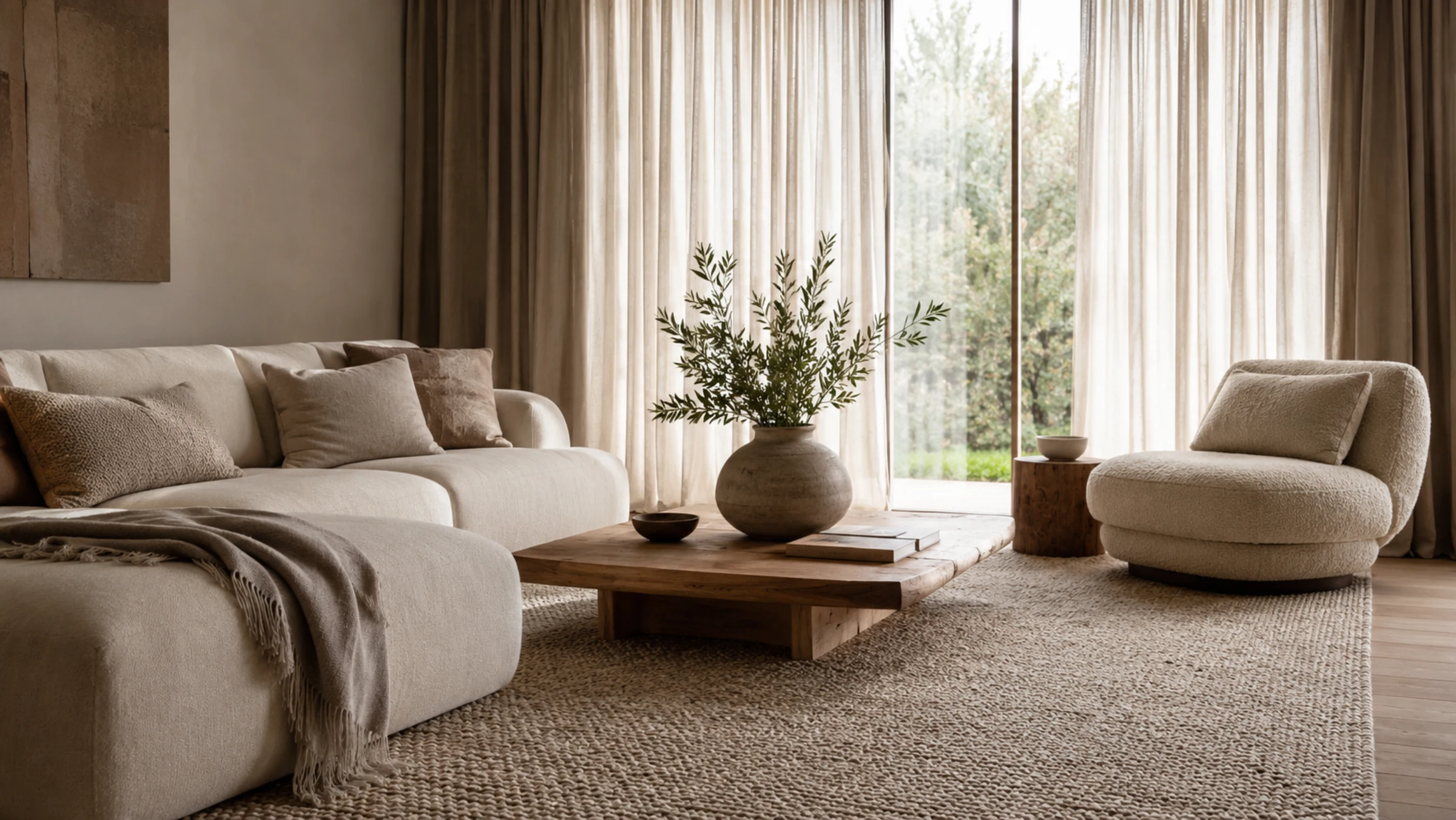
An open-plan kitchen-living-dining is the default modern residential brief. It’s also one of the worst rooms ever built for the human nervous system, and the reason is not the size, the layout, or even the screens. It’s the surfaces.
A hard floor, a glass back-door, painted gypsum walls, a concrete ceiling soffit, a stone or quartz worktop. Every surface reflects sound. Conversation, the dishwasher, the television, the children — all of it bounces around the room with very little absorption. The brain spends a meaningful share of its evening parsing speech from noise. By eight o’clock everyone is tired and nobody quite knows why.
Reverberation in plain language
The number acousticians use is RT60 — the time, in seconds, for a sound to drop by sixty decibels after the source stops. In a recording studio, RT60 is around 0.3 seconds; in a cathedral, eight to ten seconds.
In a residential room the target for restful occupation is roughly 0.4 to 0.6 seconds. A typical hard-finish open-plan room measures 1.0 to 1.5. You hear the difference: in a long-RT60 room, every sound has a tail. In a short-RT60 room, speech is crisp, music has shape, and the dishwasher fades as soon as the cycle ends.
Indicative; actual values depend on room volume, finishes, and furnishings.
Where the sound dies
Sound is absorbed by soft, porous, broken-up surfaces. Curtains, rugs, upholstered furniture, fabric panels, bookshelves with mixed-depth content, plaster walls with texture, plants. It bounces off smooth, hard ones. Glass, polished stone, ceramic tile, gloss paint over flat gypsum, lacquered timber, mirror.
Most modern interiors have shifted radically toward the hard category — floor-to-ceiling glazing, polished concrete, large-format porcelain. The aesthetic moved; the human ear stayed where it was.
Two practical rules from this:
- A residential room wants at least one large absorptive surface — ideally two. A heavy curtain across one wall, a wool rug at the centre of the room, an upholstered bedhead, a textile-clad ceiling panel
- The bigger the room and the higher the ceiling, the more absorption it needs. Volume matters. A three-metre ceiling reverberates more than a two-and-a-half-metre one even with the same finishes
What absorption actually buys you
Research from the WHO and others has documented the health consequences of long-term noise exposure, primarily focused on traffic and aircraft. Indoors, the relevant findings are subtler but real: sustained background noise above thirty-five to forty decibels is associated with raised cortisol, reduced attention, and impaired language comprehension — the last especially in children, and especially in second-language environments.
A calm room reduces the ambient floor and shortens the tail of every sound. It is, in cognitive load terms, an active piece of furniture.
The hard-to-soft ratio
A useful rule of thumb on a residential project: of the visible surfaces in a room (floor, walls, ceiling, large furniture fronts), aim for roughly half to be soft or textured. This isn’t a measurement; it’s a working diagnostic. Stand in a finished room and look at the surfaces. If more than two-thirds are hard and smooth, the room will be loud.
In a real house, “soft” isn’t about cushions. It includes:
- Floor: rug coverage roughly equal to the seating area
- Walls: at least one with textile, textured plaster, bookshelf, or a tapestry/art panel with depth
- Window: lined curtains, fabric blinds, or wooden shutters (which are better than glass and worse than fabric)
- Ceiling: most ceilings are bare. A bare ceiling in a tall room is the loudest single surface you have
What I specify
- Lined curtains on at least one window per main room, full-height where possible. Linen or wool over polyester
- A wool rug roughly the footprint of the conversation area — not a rug small enough to leave the sofa legs on hard floor
- Upholstered headboards in bedrooms, fabric or felt panels behind beds when budget allows. Both serve as ten-square-foot absorbers at exactly the height of the ear
- Clay or lime plaster on at least one major wall in living spaces. Texture absorbs; flat paint reflects. See on clay plaster
- For acoustically difficult rooms (high ceiling, glazing, open kitchen) — one fabric-clad ceiling raft or a felt panel. Modern acoustic panels look like art, not engineering. Their square-metre of coverage is the most efficient absorption you can buy
- Avoid: glass coffee tables in a glass room. Polished stone behind a sofa. Mirror-clad wardrobes in a bedroom. All three are correctable but they fight you
The test
Stand in any finished room. Clap once, sharply. Listen.
If you can hear a short, dry “clap” that ends immediately — the room is calm enough. If the clap rings, or has a tail, or seems to lift toward the ceiling and come back — the room needs more absorption.
That’s the whole test. No microphone, no app. The room either tells you it’s quiet or it tells you it isn’t.