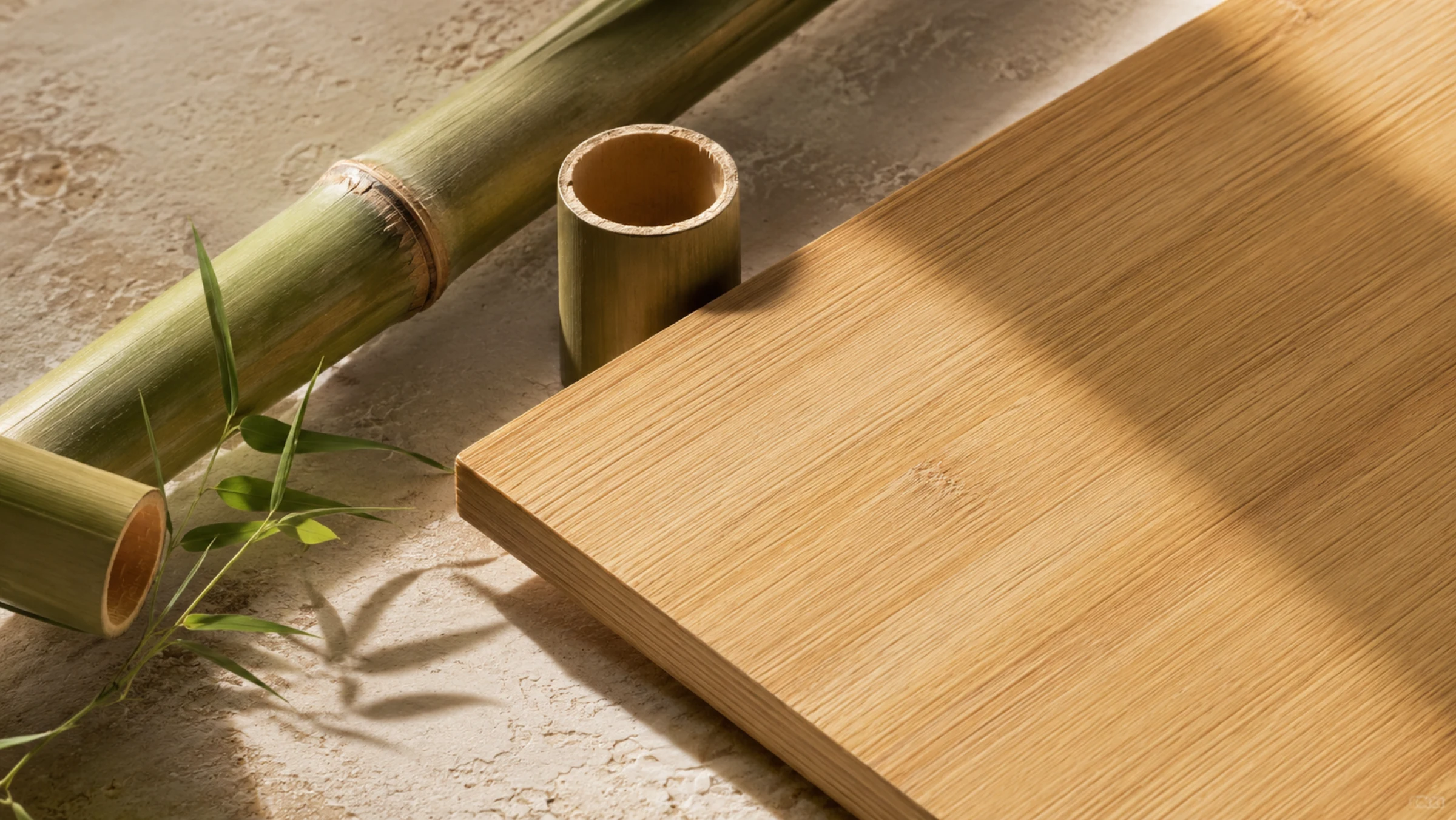
Bamboo has become shorthand for sustainable. It appears on flooring boxes, kitchen utensils, t-shirt labels, and yoga mats with the same implication: this is the planet-friendly version. Sometimes it is. Often it isn’t. The product behaves differently depending on three things the marketing rarely mentions: where it was grown, how it was processed, and what was used to glue it together.
This piece is the honest read.
What bamboo actually is
Bamboo is a grass. It’s the fastest-growing land plant in the world — Moso, the species used in nearly all bamboo flooring, reaches harvest height in three to five years versus thirty to sixty for oak. It’s also genuinely renewable: the rhizome system survives the harvest and regenerates new shoots without replanting.
All of that is real. The complication is the journey from a Chinese bamboo grove to a European or American floor.
The honest sustainability ledger
What’s genuinely good:
- Rapid renewability — harvest cycle of three to five years
- High yield per hectare compared to timber
- No replanting needed; the plant regenerates from the rhizome
- Significant carbon sequestration during growth (though most is released back when the bamboo is processed)
- Some bamboo cultivation is on land that wouldn’t support commercial timber, expanding the available agricultural base
What’s less good:
- Transport carbon. Approximately 80% of commercial bamboo is grown in China and shipped to global markets. The container journey adds material embodied carbon that timber from a local forest avoids
- Glues and resins. Engineered bamboo flooring — the kind sold as planks — is built from strips bonded with urea-formaldehyde or phenol-formaldehyde adhesives. The bamboo itself is clean. The plank is, in indoor-air terms, mostly glue
- Plantation conversion. Rising bamboo demand has been documented driving the conversion of natural forests in southern China to monoculture bamboo plantations. The biodiversity loss is real, well-reported by IUCN and others, and not visible in the FSC-labelled product
- Processing chemistry. Strand-woven bamboo is bonded under high heat and pressure with formulations that vary by manufacturer. Some are now low-emission; many aren’t
The three certifications worth asking about
FSC certification on the bamboo source. Forest Stewardship Council certification on bamboo forests is meaningful — it verifies that the plantation isn’t expanded onto cleared natural forest, that pesticide use is controlled, and that local communities are consulted. Without FSC, “sustainably harvested” is a marketing claim.
Formaldehyde-emission certification on the finished plank. The relevant standards are TSCA Title VI (US) and CARB Phase 2 (California, internationally referenced). E1 or NAF (no added formaldehyde) on the European spec sheet is the equivalent threshold.
Independent VOC certification on the finished product. Greenguard Gold or equivalent third-party testing of the assembled plank, not just the bamboo input.
A bamboo product with all three is genuinely clean. A product with none is greenwashing that happens to be flammable plant matter.
When bamboo is the right answer
Bamboo earns its place in residential interiors in three specific applications, with appropriate certifications:
- Solid bamboo flooring with FSC sourcing and NAF (no added formaldehyde) construction. Strand-woven solid bamboo is harder than oak and significantly harder than most softwoods, which makes it appropriate for high-traffic areas where a softer wood would dent
- Bamboo kitchen utensils, cutting boards, and small homewares — cleaner end of the supply chain and a meaningful substitution for plastic
- Visible-grain bamboo joinery (open-shelving, cabinet faces) where the material is doing aesthetic work and there’s less square-meterage on which glue chemistry compounds
When it isn’t
In several conventional applications, the case for bamboo is weaker than the case for the alternative I’d otherwise specify.
- Engineered bamboo plank flooring with unspecified adhesives. The off-gassing risk swamps the renewable-material benefit. Solid cork, reclaimed oak, or natural linoleum all beat this version
- Bamboo textiles marketed as “bamboo fibre.” Most are bamboo viscose — bamboo cellulose dissolved in carbon disulfide, a process whose worker-health record is documented by the US FTC as misleading when sold as “natural bamboo”. Organic cotton or linen is generally a cleaner choice
- Bamboo-themed decorative imports of unknown provenance. Without certification, the supply chain is opaque. Skip
What I specify
- Solid strand-woven bamboo flooring, FSC-certified, NAF (no added formaldehyde) or compliant with TSCA Title VI / CARB Phase 2 / EU E1. Hard-wax oil or natural shellac surface finish
- For engineered bamboo plank: only when the manufacturer publishes both formaldehyde-emission and Greenguard Gold testing. Several do; many don’t
- For utensils and small homewares: FSC where labelled; otherwise prefer reclaimed wood or olive wood from local sources
- For textiles: no bamboo viscose. Linen, hemp, or GOTS-certified organic cotton instead. See on linen & hemp
The grass is real
Bamboo is a remarkable plant. The flooring made from it is a manufactured product whose sustainability is determined almost entirely by the manufacturer’s decisions, not the plant’s. The grass grew in three years; the spec sheet is what matters.
Ask for the certifications. If they aren’t there, ask why. If the answer is vague, the answer is no.