Most building materials require killing something to acquire. Wood requires felling the tree. Stone requires quarrying the mountain. Even “natural” finishes leave a visible subtraction from the landscape they came from.
Cork is one of the few materials that doesn’t. The bark is stripped from the living cork oak (Quercus suber) every nine years — the tree continues to grow, regenerates the bark, and lives for two centuries doing it. The forest stays forest. The forest is, in fact, more biodiverse because of the harvest, not in spite of it.
What it is
Cork is the outer bark of the cork oak, a tree native to the western Mediterranean. Portugal produces roughly half the world’s cork; Spain, Morocco, Algeria, Italy, and France produce most of the rest. The bark is harvested by hand, every nine years, by skilled workers who strip sections of the trunk with an axe in a method essentially unchanged for two thousand years.
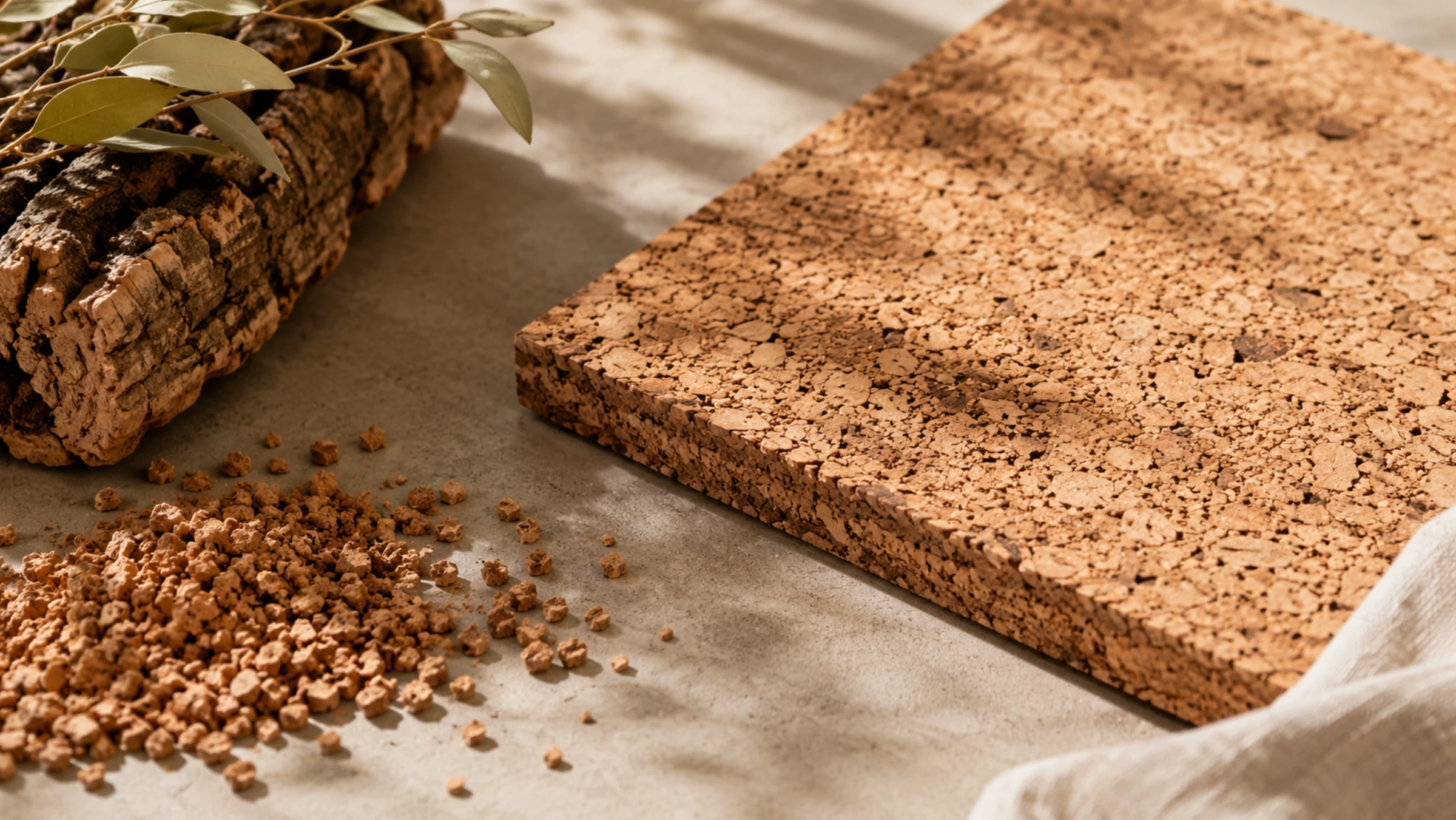
Once harvested, the bark is boiled, flattened, and either punched (for wine stoppers, which take the highest-grade material) or granulated and re-bonded with natural binders into sheets, tiles, panels, and insulation blocks. The lower-grade material that doesn’t make a stopper is the material used in interiors.
What it does
Cork is structurally unusual: a closed-cell foam made of fourteen-sided cells filled with air. That structure gives it a set of properties that no other natural material combines.
- Thermal insulator. Roughly the insulation value of mineral wool, per centimetre. A cork-lined wall is measurably warmer underfoot and against the body
- Acoustic absorber. The cell structure traps sound. A cork-tiled floor or wall absorbs both impact noise (footsteps) and airborne noise (conversation, music)
- Naturally fire-resistant. Cork chars rather than flames; it’s self-extinguishing and produces little smoke. The Portuguese Cork Association documents Class B-s1,d0 ratings on standard products
- Hydrophobic and antimicrobial. Suberin, the waxy compound that fills the cell walls, repels water and discourages mould and bacteria
- Resilient. The closed-cell structure returns to shape under compression. A cork floor that’s been walked on for fifty years recovers; a vinyl floor in the same room is in a landfill
What it does for the planet
Cork oak forests are one of the highest-biodiversity ecosystems in Europe. The Mediterranean Basin Biodiversity Hotspot hosts species that depend on the managed-forest mosaic that cork production maintains — the Iberian lynx, the Spanish imperial eagle, the Barbary deer. When cork demand drops, these forests are abandoned or converted to eucalyptus monoculture, and the species disappear.
Cork is also carbon-negative on a lifecycle basis. The tree absorbs CO2 while regrowing its bark; the bark itself stores carbon for the life of the product; manufacturing energy is low. Used cork can be ground and reused, composted, or burned for energy. There is no landfill destination at the end of life that creates a problem.
Where it goes wrong
Two cautions.
Composite cork tiles often use synthetic binders. Cheap cork flooring marketed as “natural” can contain polyurethane or formaldehyde-based adhesives that compromise the indoor-air case. Look for products that specify natural binders — suberin-based or starch-based — or solid agglomerated cork.
The finish layer matters. Cork floors are usually sold pre-finished with a clear surface coat. Many of these coats are conventional water-based polyurethane — durable but not the cleanest chemistry. Hard-wax oil, natural shellac, or unsealed (for low-traffic areas like wall panels) are cleaner finishes.
Where I use it
- Bedroom and study floors. Warm underfoot, quiet, soft on the joints. The two main applications I default to
- Wall panels for acoustic improvement. A two-metre-by-one-metre cork panel in a home office is a meaningful acoustic intervention. See the acoustics of a calm room
- Kitchen pinboards, banquette seat-backs, headboards. Low-traffic vertical surfaces where the tactile depth reads, and the resilience matters
- External-wall insulation in renovations. Expanded cork board (the dark-brown thermally treated kind) is a high-performance insulation that’s vapour-open, fire-safe, and entirely biodegradable. Used on the back wall of the firehouse residence
What I specify
- FSC-certified cork from a named supplier. Amorim Cork (Portugal) is the largest and most transparent
- Natural binders only on agglomerated products. No formaldehyde glues, no polyurethane carriers
- Hard-wax oil or natural shellac as the surface finish; pre-finished only if the tech sheet specifies a water-based, low-VOC coating
- For external insulation: expanded cork agglomerate (ICB) — the carbon-negative high-density board, not the lower-density acoustic underlay
The forest stays
Few materials let you finish a floor and improve a forest in the same transaction. Cork does that, and has done it for two thousand years. It’s sitting in the underwriter’s history of every wine cellar in the Mediterranean basin. We could probably use a bit more of it in the rest of the house.