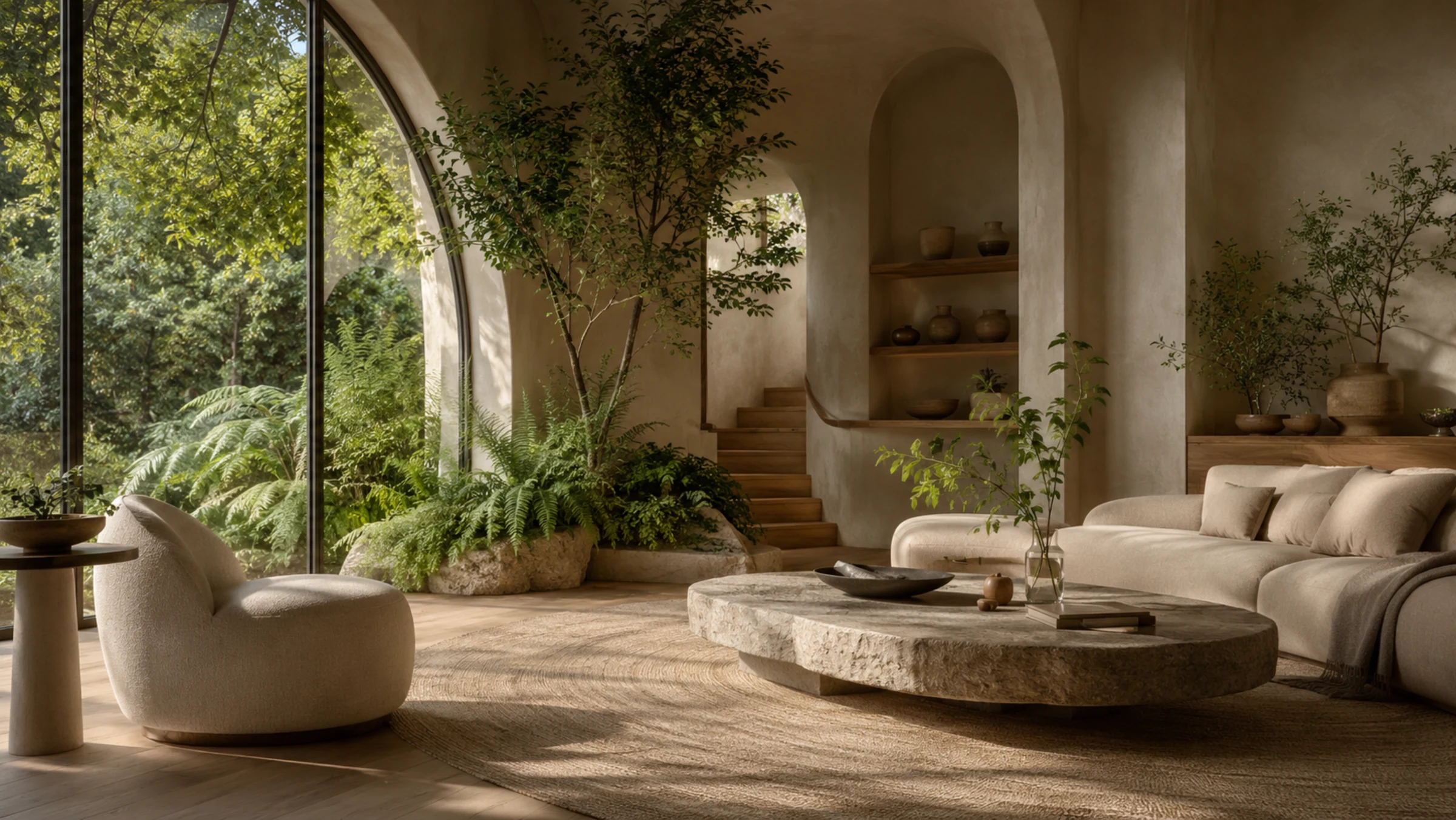
“Biophilic” has become a marketing word. A single trailing pothos in the corner of a co-working space is described as biophilic design. So is a strip of moss above a reception desk and a faux-grass photo wall in a children’s clinic. The word has stretched far enough that it has nearly stopped meaning anything.
What it actually describes, in its honest definition, is a set of design moves that consistently produce measurable physiological effects in the people occupying the space — lower cortisol, slower heart rate, reduced blood pressure, faster recovery from cognitive load. It’s not a style. It’s a category of interventions with replicable outcomes.
The founding study
In 1984, Roger Ulrich, then at the University of Delaware, published a paper in Science titled “View through a window may influence recovery from surgery.” He compared two groups of patients in a Pennsylvania hospital recovering from gallbladder surgery. The rooms were identical except for what was outside the window: half looked at a brown brick wall; half looked at deciduous trees.
The tree-view patients recovered faster — on average, just under a day shorter in hospital — took fewer strong analgesics, and had fewer negative notes from staff. The architecture had done a measurable share of the medicine.
What replicated
Forty years of research have widened the original finding. The headline effects, documented across hospital, office, school, and residential studies:
- Viewing real or representational nature lowers measured cortisol, heart rate, and blood pressure within minutes
- Attention restoration — the capacity to focus after a depleting task — improves more in nature-rich settings than in equivalent built-environment-only settings (Stephen and Rachel Kaplan, Attention Restoration Theory)
- Workplace studies (compiled in Terrapin Bright Green’s “14 Patterns of Biophilic Design”) document productivity and creative-task improvements in offices with daylight and views
- School studies show classrooms with daylight and outdoor views correlate with measurable improvements in test scores and reduced absenteeism
- The WELL Building Standard and BREEAM both incorporate biophilic provisions on the strength of this evidence base
These are population-level findings with effect sizes that vary; not every individual responds the same way. But the direction of the effect is consistent across the literature.
The four moves that do most of the work
Of the fourteen patterns Terrapin Bright Green catalogues, four account for most of the documented physiological effect. The rest are useful refinements.
Daylight. Direct or diffuse natural light, ideally from more than one orientation. The circadian benefits sit on top of the mood and cognitive ones — daylight is the single biggest input the body uses to set its clock. See the blue light at 10pm.
Views to nature. Vegetation, water, or sky, visible from primary occupied positions. A view of a single tree is meaningfully different from a view of a brick wall, even when the rest of the room is identical. Where a real view is impossible, large-scale nature photography or moving-water imagery on a screen produces a measurable fraction of the effect, though less than the real thing.
Natural materials. Wood, stone, clay, wool, linen, cork. Their visible grain, irregularity, and tactile depth read as “natural” to the perceptual system in ways that uniform synthetic surfaces do not. The mechanism is partly visual (fractal complexity), partly tactile, partly olfactory in the case of timbers.
Living plants. Not as ornament, but as a piece of the room’s biology. Plants modestly improve indoor air quality (the magnitude varies; EPA reviews caution that single houseplants alone don’t materially clean room-scale air). The larger effect is psychological: a visible, alive, growing system in the room.
What it isn’t
A single corner pot doesn’t do this work. Faux greenery doesn’t do it. A green-coloured wall doesn’t do it. The research is specific enough that we know which interventions read to the body and which read only to the camera.
A useful test: if the “biophilic” element of a room is removed and the room functions identically — same light, same materials, same view — the element was decorative, not biophilic.
What I specify
- Daylight planning before furniture. Where the seats face determines the dose. South-facing windows behind a sofa give the most daylight to the room; the people on the sofa see least of it. Adjust the plan
- Views composed deliberately. The view from the kitchen sink to the garden is treated as a finish item, not a coincidence. Where the view is bad, an interior landscape (a deep planted shelf, a long-lived olive in a corner) replaces it
- Wood with visible grain, stone with visible vein, clay plaster with visible trowel marks. Smooth-laminate everything reads as a hotel, not a room
- Plants at the scale of the room. One large specimen tree in a corner reads better than five small pots scattered. Choose for low maintenance — Ficus lyrata, Strelitzia, large Monstera, mature olive — and place where they get the light they need
- For workplaces: living wall over a moss panel; moss over a printed graphic. Effort matters, because real systems behave like real systems
The honest version
A biophilic room isn’t one that contains nature. It’s one designed so the body recognises that it’s indoors but isn’t indoors in the way that depletes us. The clue is in the recovery curve — cortisol dropping, breath slowing, attention returning — not in how many leaves are in the photograph.
Get the four moves right and the rest decorates itself.