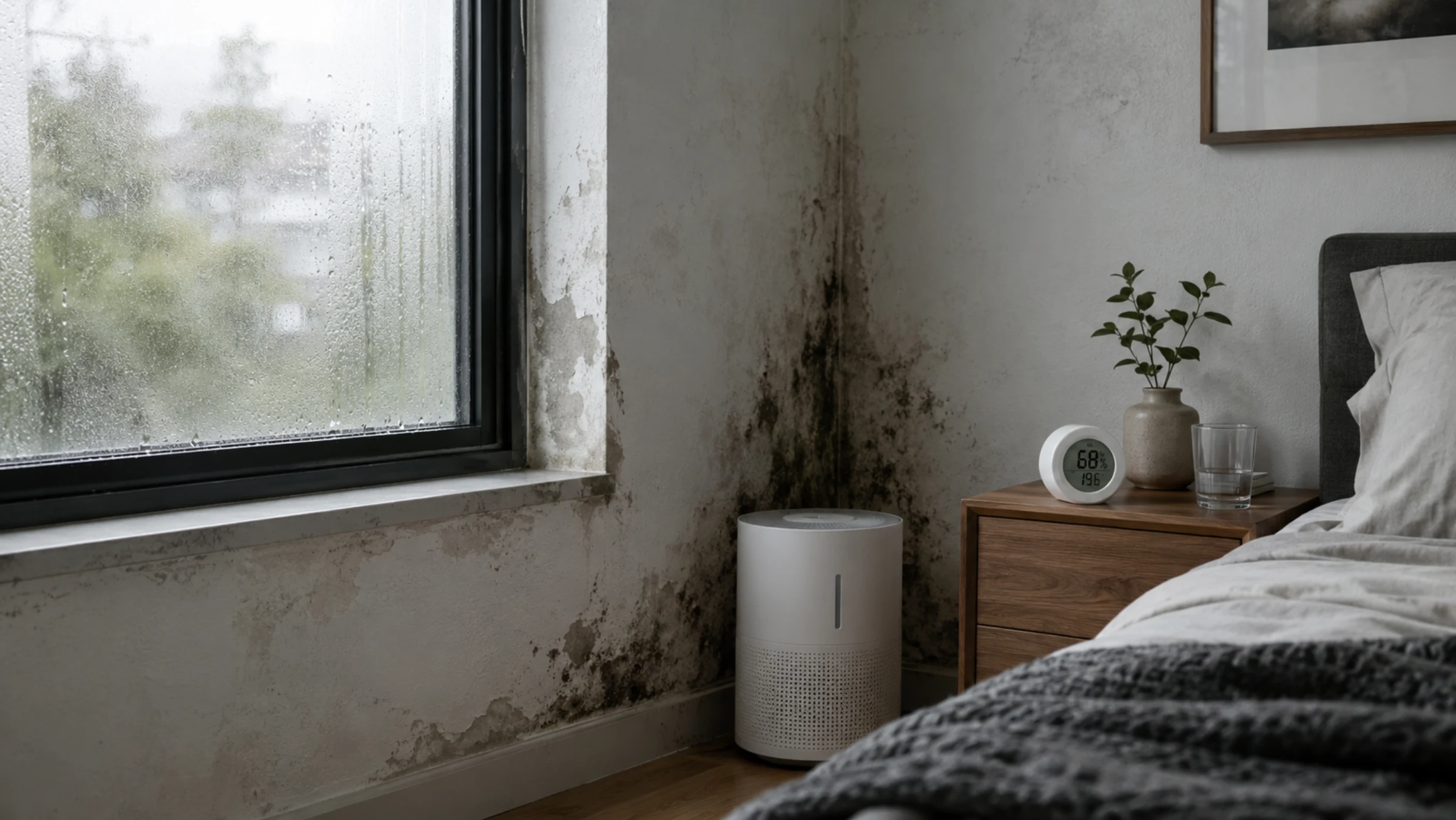
A bathroom ceiling develops a black patch. Someone scrubs it with bleach and rolls white paint over it. Two months later it’s back, in the same place, the same shape, slightly larger. This sequence is the most common mould story I hear in residential consultations.
It is also a story about a problem the painting was never going to solve.
What mould is, mechanically
Mould is a fungus. Spores are airborne everywhere — they’re a normal part of indoor and outdoor air. They become a visible mould patch only when three things meet: a food source (organic dust, paper face of drywall, wallpaper paste), a stable surface, and moisture above a threshold.
The food and the surface are everywhere in any building. The variable that determines whether the spores land and grow is the moisture.
The 60% rule
The WHO Guidelines on Dampness and Mould and the EPA Mould Course agree on the operating principle: keep sustained relative humidity below sixty percent and most common moulds can’t establish. Above that, you’re managing the rate of growth, not preventing it.
Buy a fifteen-euro hygrometer. Put it in any room with recurring problems. If it reads above 60% for hours at a time, the room has the problem; the paint is a symptom.
Where the moisture comes from
Four sources, in rough order of how often they cause indoor mould:
- Inadequate kitchen and bathroom ventilation. Cooking and showering put litres of water vapour into the air. If it’s not extracted, it condenses on the coldest available surface — often the bathroom ceiling, often the corner of an outside wall behind furniture
- Cold spots from thermal bridges. A wall corner, a window reveal, the inside face of an external wall behind a wardrobe. Surface temperature drops below the dew point of the room air, water condenses, mould grows
- Drying laundry indoors. A full load releases two to three litres of water into the air over a few hours, mostly into the room with the worst ventilation
- Building leaks. Roof, pipework, rising damp. These are the obvious ones and almost never the cause; if they were, the water mark would be larger than the mould patch
The fix is the air
In every case the fundamental answer is the same: reduce the moisture content of the room air. The methods vary by source.
Ventilation. An extract fan in the bathroom that actually moves air — sixty to eighty litres per second for an enclosed bathroom, ducted to outside, run for fifteen minutes after a shower. A range hood in the kitchen, also ducted out (not the recirculating kind), used every time you boil water for more than five minutes.
Heating. Counterintuitive but central: warm air holds more moisture without condensing. A cold bathroom condenses every shower onto its walls. A bathroom heated to nineteen or twenty Celsius during the showering hour holds the same vapour as vapour, where the extractor can remove it.
Thermal continuity. Cold corners and uninsulated external walls are an architectural problem, not a paint problem. Where remediation is possible, internal insulation with a vapour-open finish (lime plaster, clay plaster, mineral boards) addresses both the cold-spot and the moisture-buffering question in one move.
Materials that breathe. A gypsum-board-with-paint wall is essentially a sealed surface. When humid air meets it, the moisture has nowhere to go but condensation. A vapour-open wall — clay plaster or lime plaster — absorbs moisture during humid hours and releases it during dry ones. It doesn’t replace ventilation, but it buffers the swings that drive condensation.
Why painting over it doesn’t work
Bleach kills surface mould; it doesn’t change the conditions that produced it. Mould-resistant paint slows recolonisation; it doesn’t remove the water that keeps arriving. As soon as the next shower’s vapour condenses on the same cold ceiling, the same patch returns.
The painted-over wall is also dangerous in a quieter way. Mould that’s been sealed behind paint can continue to grow on the inside face of the drywall, releasing spores and mycotoxins into the wall cavity. The room looks fixed. The air in it isn’t.
What I specify
- Bathroom fans rated for the actual volume, ducted to outside, on a humidity-sensing switch where possible. No recirculating extract
- Range hoods, ducted, sized for the burner load. Recirculating hoods are tolerable only in apartments where ducting isn’t possible — and then only with high-grade carbon filters
- Walls in clay or lime plaster where moisture loading is high. The kitchen back-wall behind the cooker, the bathroom ceiling, the cold outside-facing wall in the bedroom: these are the places where the finish does work
- Heating zoned so cold rooms can be brought up to room temperature during use, not left at fifteen degrees because they’re “just bathrooms”
- For existing buildings with recurring problems — a humidity log over two weeks before specifying anything. The log usually shows the problem clearly
The honest read of the patch
A mould patch is the room telling you something specific: this surface is below the dew point for a fraction of every day, and the air doesn’t leave fast enough. Painting it over rejects the message.
Read the patch. Then change the air.