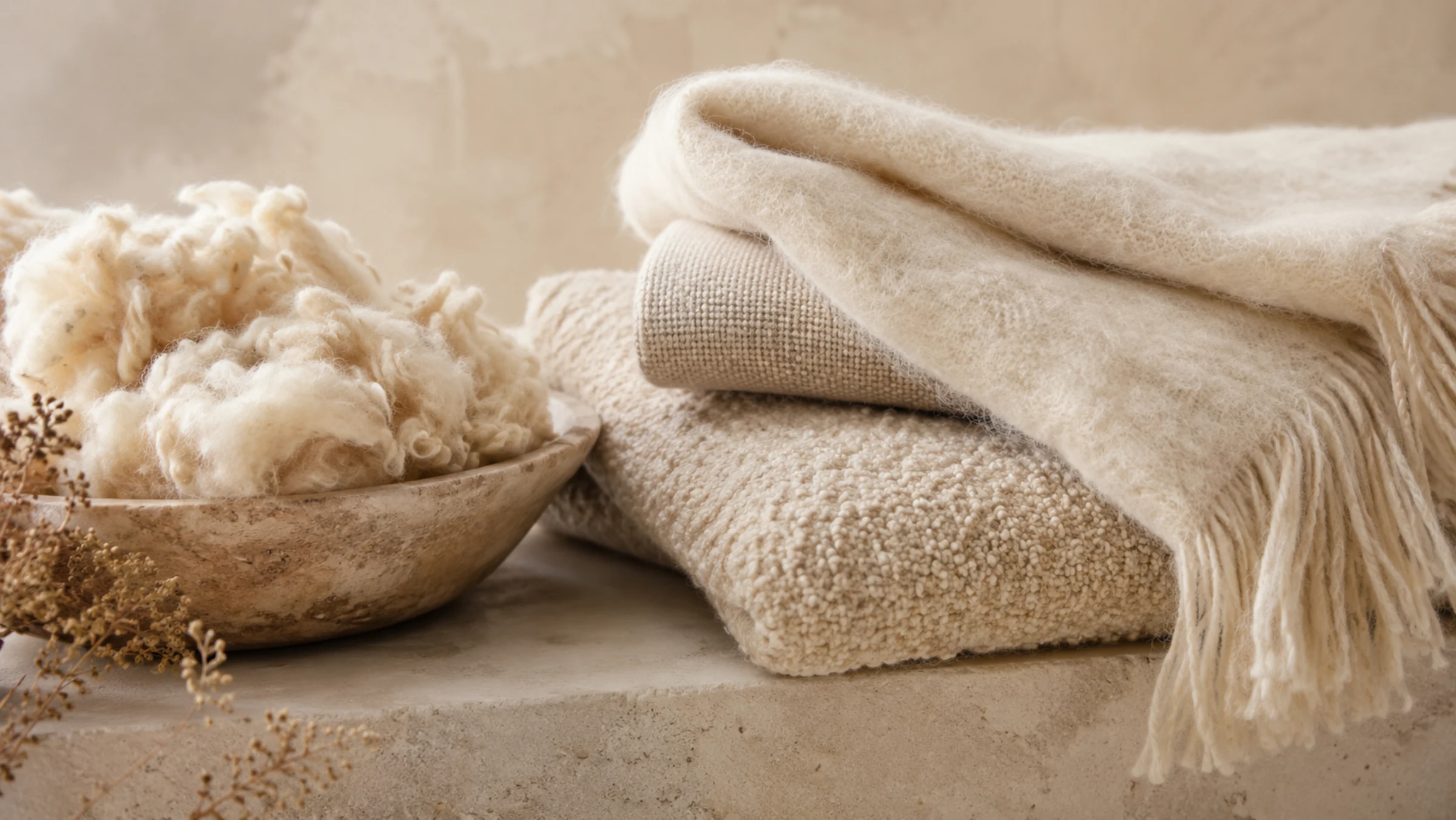
Of all the materials in an average house, wool is the one that has been most thoroughly displaced by something worse. Carpets that used to be wool are nylon. Sweaters that used to be wool are acrylic. Bedding that used to be wool-filled is polyester batting. Insulation that used to be wool, or felt, or cellulose, is now polystyrene foam or rock-fibre with phenolic binders.
Each of those substitutions saved money and gave up a material whose properties we’ve been trying to replicate, badly, ever since.
What wool is, mechanically
Wool is the protein fibre from sheep, primarily, though similar fibres come from alpaca, goat (cashmere, mohair), and rabbit (angora). The fibre is a complex structure of keratin proteins arranged in overlapping scales around a hollow core, with a natural crimp that gives it loft. That structure produces a set of properties that no synthetic fibre fully matches:
- Inherently flame-resistant. Wool requires significantly more oxygen and energy to ignite than synthetic fibres. It chars rather than melts, doesn’t sustain flame, and produces less toxic smoke. The reason airline seat covers and military uniforms specified wool for decades
- Moisture-regulating. Wool can absorb up to 30% of its weight in moisture without feeling wet, then release it slowly. Both bedding and clothing made from wool are comfortable across a wide humidity range
- Naturally antimicrobial and odour-resistant. Wool doesn’t host bacteria the way synthetic fibres do, which is why a wool sweater can be worn many times between washes
- Thermally insulating. The crimp creates air pockets, the air pockets do most of the insulating. A wool blanket, a wool rug, and a wool insulation panel all rely on the same property
- Resilient and self-cleaning. Wool fibres spring back from compression. Wool carpets in occupied rooms keep their texture far longer than synthetic fibres in the same use
- Biodegradable. A wool textile in the ground returns to soil within a year or two, releasing only nitrogen and amino acids. A synthetic carpet in the same hole is still there in fifty years
Where it goes in the house
Rugs. Wool is the right material for almost any rug. It wears well, recovers from compression, doesn’t shed microplastic, and the manufacturing process is centuries-mature. Wool over synthetic latex backing is the common compromise; wool with cotton or natural-rubber backing is the cleaner spec.
Bedding. A wool topper on a natural-latex mattress is one of the cleanest sleep stacks available. Wool duvets and pillows are heavier than down but regulate temperature better and have no flame-retardant treatment to worry about — the wool does that job by itself.
Upholstery and curtains. Wool upholstery fabric (Kvadrat’s wool ranges, for example) is the standard for high-end residential and contract seating. The fabric resists dirt, hides stains, and survives daily wear better than cotton in most positions.
Insulation. Sheep’s wool building insulation has been used in northern Europe for decades and is widely available as batts and rolls. It performs comparably to mineral wool thermally, beats it on humidity buffering and acoustic absorption, and is biodegradable at end of life. The remaining barrier is mostly availability and habit.
Felt panels. Densified wool felt panels are the cleanest acoustic absorber on the market — PET-felt panels (the recycled-bottle version) are common but not as clean; pure wool felt is harder to find but worth the search.
The ethical and environmental questions
Wool is an animal product, and animal welfare is a real consideration in any specification. The honest reading:
Mulesing is a procedure widely practised on Australian merino sheep that has drawn legitimate animal-welfare criticism. Responsible Wool Standard (RWS) certification and ZQ Merino certification both prohibit mulesing and require independently audited welfare standards. Either label on the merino product addresses the concern.
Grazing impact varies enormously by geography and practice. Regenerative sheep grazing on appropriate land builds soil carbon and supports grassland biodiversity. Intensive overgrazing on marginal land does the opposite. The honest answer here is the same as for beef — the practice matters more than the headline.
Lifecycle carbon of wool is moderate, primarily from enteric methane from sheep. It’s higher than linen or hemp per kilogram, lower than conventional cotton in many studies, and dramatically lower than polyester when end-of-life biodegradability is included.
Where wool isn’t the answer
For clients who avoid all animal products, the alternatives are linen, hemp, organic cotton, jute, sisal, and seagrass. Each has its specific strengths; none replaces wool perfectly in every application, but the substitutions are real and available.
Beyond that, two practical limits to wool: it can shrink and felt if washed incorrectly (cold-water hand wash or dry-clean is the conservative care), and the upfront cost is higher than synthetic equivalents. The life-cycle cost is usually lower because the product lasts decades, not seasons.
What I specify
- 100% wool for rugs, with cotton or natural-rubber backing where available. Avoid synthetic latex backings if possible
- Responsible Wool Standard or ZQ certification for any merino product (sweaters, fine bedding, soft upholstery)
- British, New Zealand, or European wool for projects in those regions — reduces transport, supports local rare-breed husbandry
- Wool flame retardancy used as the design choice in mattresses and bedding rather than chemical retardants. See what’s in your mattress
- Densified wool felt acoustic panels (Filzfelt, for example) where the budget permits; PET felt as the acceptable fallback when wool isn’t available
- Sheep’s wool building insulation in renovation projects where the wall cavity is being opened — particularly bedrooms and timber-frame construction
The fibre that should have stayed
Most of the synthetic-fibre revolution was driven by cost, not by anything wool wasn’t doing. Nylon carpet cost less per square metre. Polyester batting cost less per kilogram. Acrylic sweaters cost less than wool ones. Each substitution moved a bit of fossil chemistry into a position that wool had held for several thousand years.
The cost calculation looks different at the end. Wool lasts. The synthetics shed microplastic with every wash, get replaced every three years, and outlast the building they came from in the landfill. The cheaper material was never cheaper.
Buy the wool. Wash it cold. Pass it on.