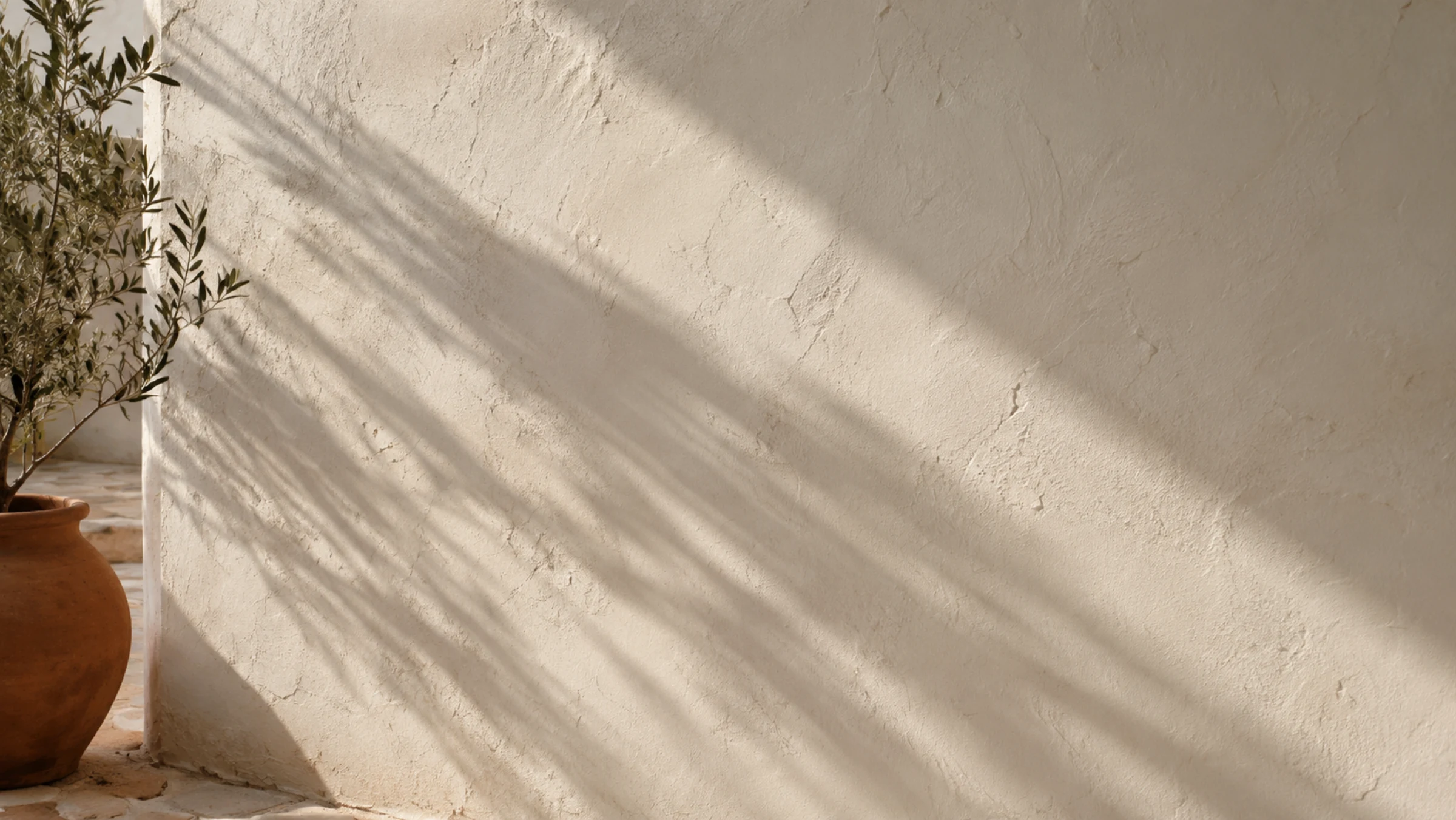
If you have ever been inside an old church in southern Europe and noticed how the white walls glow rather than reflect, that’s lime. If you have ever walked into a centuries-old Mediterranean village and felt the walls were softer than they look, that’s lime. The Roman aqueducts were lime-mortared. The pyramids have lime in them. Almost every building older than reinforced concrete has lime somewhere in its construction.
Then we replaced it with cement, gypsum, and acrylic, and forgot how good it was.
What lime is
Lime, for building purposes, is calcium hydroxide — limestone (calcium carbonate) that has been burned in a kiln to drive off carbon dioxide, then slaked with water to a putty. Spread on a wall, it slowly re-absorbs CO2 from the air and reverts to calcium carbonate. The wall, in chemical terms, becomes limestone again. The cycle is closed.
Two main forms are used in interiors:
Lime plaster — calcium hydroxide mixed with sand and water, applied in two or three coats. Thicker, harder, and more durable than limewash; the structural wall finish.
Limewash — a thin, milky paint made of slaked lime and water (sometimes with mineral pigment). Brushed on in three or four diluted coats. Soaks into the substrate, cures by carbonation, becomes part of the wall rather than a film on top of it.
What lime does that paint cannot
Like clay plaster, lime is vapour-open. Moisture passes through the wall in both directions. Unlike clay, lime is also significantly harder, slightly more water-resistant, and has a higher pH (around 12 when fresh) that makes it strongly resistant to mould and bacteria.
- Antimicrobial. The high pH of curing lime is hostile to mould, mildew, and bacteria. Lime-finished bathrooms are documented to stay mould-free in conditions where painted ones don’t. See mould is a humidity problem
- Vapour-open. Moisture moves through; the wall buffers humidity swings and avoids the condensation that drives mould growth
- Self-healing. Hairline cracks in lime plaster re-knit themselves over time as moisture in the air dissolves and re-deposits calcium carbonate across the crack. Cement does not do this; gypsum does not do this; only lime does this
- CO2-absorbing during cure. Every square metre of lime plaster sequesters a measurable mass of carbon over its first decade as it carbonates. The wall is, literally, taking carbon out of the air
- Beautiful. The slight unevenness, the depth of pigment that lives in the wall rather than coating it, the way it changes with raking light. Lime-finished walls have a quality that painted walls don’t, and never will
Where lime fits and cement doesn’t
A practical consequence: lime is the right finish for old buildings. Almost every traditional masonry wall — stone, brick, cob, rubble — was built to be vapour-open. Painting cement render and modern acrylic paint over those walls traps moisture inside the wall, which then condenses against the cold inner face and damages everything behind. Many of the “rising damp” problems in old European housing stock are not rising damp at all — they are the building being asphyxiated by an impermeable modern coating.
Lime plaster over an old masonry wall lets the wall breathe the way it was designed to. The repair is, in a real sense, structural conservation rather than redecoration.
Where it’s a hassle
Lime is a working material, not a paint. Three real limitations.
It needs a skilled trade. A drywall painter cannot apply lime plaster well. The substrate, the mix, the timing of each coat, the curing — all are specific. The supply of trained lime applicators is improving but still thin outside heritage regions.
It is caustic before it cures. Fresh lime burns skin and eyes. The trade wears full PPE; the occupant is out of the room during application and for two to three days afterwards.
It moves with the building. Lime is slightly softer and slower-curing than cement; it tolerates the small movements of a settling masonry wall in ways cement doesn’t. This is a feature in old buildings and a question in new ones, where the wall may not move enough for lime’s flexibility to be necessary.
Limewash specifically
Limewash is one of the simplest finishes available — slaked lime, water, sometimes a natural pigment. It costs almost nothing, applies with a wide brush, and produces walls that read very differently from painted ones. Three things to know:
- It only works on porous, mineral substrates. Brick, stone, plaster, cob, lime-finished render. It will not adhere properly to gloss-painted gypsum board or to anything synthetic
- It is applied in three to four very dilute coats. The first coat looks alarmingly streaky. The fourth disappears into a luminous, depth-y surface
- It chalks lightly on the surface for the first few weeks. This is curing, not failure. Wipe it off; the finish stabilises
What I specify
- Lime plaster for the bathrooms and kitchens of heritage-renovation projects where the wall substrate is old masonry. The vapour-open, antimicrobial, self-healing combination is hard to beat in a humid room
- Lime plaster as a wall finish in any room where moisture loading is moderate and the look reads right — warm whites, soft ochres, the pale lime greens of Spanish villages
- Limewash for exterior walls in heritage projects, and for interior accent walls in any room where the substrate supports it
- Hydraulic lime (NHL) where the wall sees water (bathroom, exterior); air lime (CL90) where it doesn’t. The distinction matters and the bag will say which
- Trusted suppliers: Womersleys, Cornish Lime, Beeck Mineral Paints, St. Astier. Local suppliers are often better — lime travel-cost is silly
The wall that becomes limestone again
There is something quiet and slightly philosophical about a wall finish that, over the course of a decade, slowly reabsorbs the carbon dioxide that was driven out of the limestone in the kiln. The wall in your dining room is, slowly, becoming stone again.
That’s the right kind of permanence to build with. Slower than paint, harder to apply, finer to look at, mostly invisible in its sustainability work. Lime has been making walls for ten thousand years; the modern materials that displaced it have been around for sixty. The longer view, in this case, is also the older one.