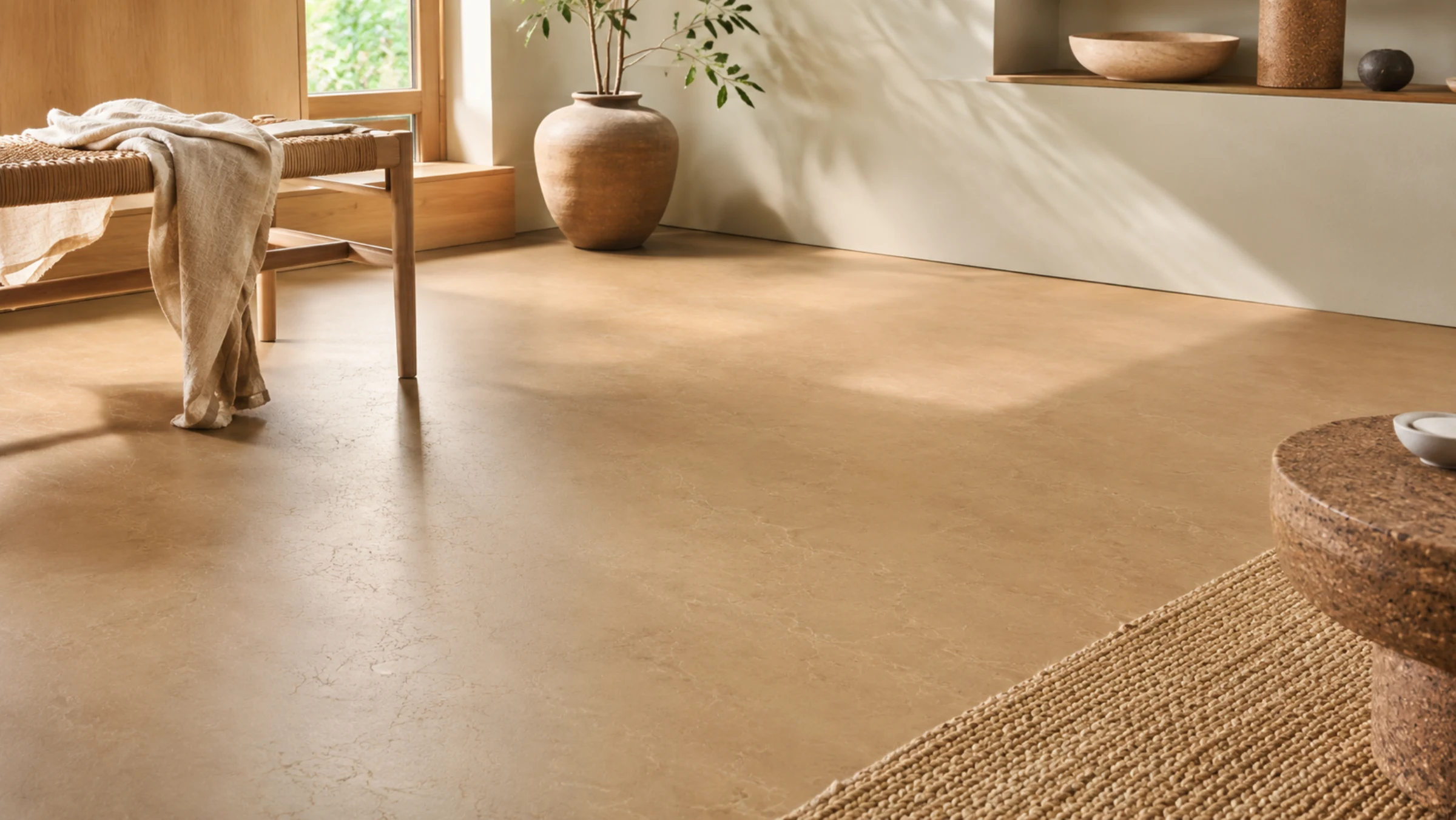
Almost everyone has touched linoleum and called it vinyl. The two materials look broadly similar from across a room, and the modern flooring trade has spent fifty years deliberately blurring the line. They are, chemically and environmentally, opposites.
Natural linoleum is a 19th-century invention that turned out to be quietly perfect. Vinyl — PVC — replaced it in the 1960s for cost reasons and remains the dominant resilient floor in the world, despite a long and well-documented list of health and disposal problems. We’ve been using the wrong one for sixty years.
What linoleum actually is
Patented in 1860 by an Englishman named Frederick Walton, natural linoleum is made of five ingredients, all biological:
- Linseed oil — oxidised, polymerised flax-seed oil; the binder and the source of the name
- Pine rosin — tree resin, adds flexibility and water resistance
- Cork or wood flour — fine cellular powder for resilience and texture
- Limestone powder — calcium carbonate, the bulk filler
- Jute backing — the woven cloth that holds the sheet together
Mineral pigments are added for colour. The ingredients are mixed, calendered onto the jute backing, and cured for two to three weeks in a heated chamber where the linseed oil oxidises into a tough, slightly rubbery sheet. The whole process uses agricultural by-products and produces no synthetic chemistry.
What it does
- Resilient. Slightly soft underfoot. Comfortable to stand on for long periods, which is why hospitals and schools have used it for a century
- Naturally antimicrobial. Oxidising linseed oil continues to produce small amounts of antibacterial chemistry across the life of the material. A documented part of why it remained the hospital floor of choice through most of the twentieth century
- Durable. Forty to fifty years of service in commercial settings. Hospital floors laid in the 1950s are still in service
- Fire-resistant. Self-extinguishing; produces little toxic smoke when burned (unlike vinyl, which releases hydrogen chloride and dioxins)
- Biodegradable. Composts at end of life. Will not last in landfill the way a vinyl floor will
- Carbon-negative or carbon-neutral over life cycle, depending on the analysis — the linseed and cork inputs sequester carbon during growth that the manufactured product retains
Linoleum vs. vinyl — the comparison nobody runs
The two materials are almost always sold side by side, in similar formats and similar price ranges. The lifecycle ledger is not similar.
Vinyl (PVC): petroleum-derived. Manufactured with chlorine gas. Plasticised with phthalates, many of which are endocrine disruptors and several of which are restricted under TSCA. Off-gasses for years. Cannot be recycled meaningfully in residential streams. In a fire, releases hydrogen chloride and dioxins.
Natural linoleum: plant-derived. No phthalates. No PVC. Minimal off-gassing (a faint linseed-oil smell during the first two weeks of installation). Biodegradable. In a fire, self-extinguishes with low toxicity. Carbon-neutral or negative over the lifecycle.
The price difference is roughly twenty to forty percent at retail. Per year of service, linoleum is cheaper than vinyl by a wide margin. The barrier to specifying it is awareness, not cost.
Where I use it
- Kitchens. Resilient, easy on the back, survives water and grease, scrubs clean. The default I recommend over both tile and vinyl plank in any residential kitchen
- Bathrooms in residential settings where a sheet product is preferred over tile (an entire bathroom in one continuous, jointless sheet has its appeal). Sealed seams and a turn-up at walls is the detailing
- Children’s playrooms and primary schools. Soft enough to fall on, durable enough to survive twenty years of children
- Hospitality back-of-house and certain casual front-of-house floors. The hospital lineage means it’s rated for institutional traffic; in a residential project the same rating means twenty years of unworried use
Where it doesn’t go
Two cautions.
Not over high-moisture concrete slabs without a vapour barrier. Jute backing is biological; it can rot if installed over a slab that’s actively wicking moisture. Test the substrate; install the recommended primer.
Not in primary living rooms or bedrooms in projects where the aesthetic brief asks for timber or stone — this isn’t a chemistry issue, just an aesthetic one. Linoleum reads as a working floor. Reclaimed oak or cork are warmer for sitting rooms.
What I specify
- Forbo Marmoleum is the dominant brand and the one whose technical data and supply chain I trust. (Linoleum is a generic material; “Marmoleum” is Forbo’s specific product line.)
- Sheet over tile format for kitchens; tile only where a specific pattern is the design intent
- Natural cork underlay over conventional foam — keeps the stack biodegradable
- Welded seams in wet areas; cold-cut joints elsewhere
- Avoid “linoleum-look” vinyl. The product name is the legal way to sell a vinyl-tile floor with a linoleum-style pattern. It’s vinyl
A material that should have stayed
The displacement of natural linoleum by vinyl is one of the cleaner case studies of how a worse product wins on price and marketing alone. There’s nothing wrong with linoleum that the planet and the lungs of the people in the building haven’t been telling us was wrong with vinyl for sixty years.
The simpler way to write a sustainable kitchen brief is to spec it the way 1955 would have. The material is still there. So is the factory in the Netherlands that’s been making it continuously since 1898.