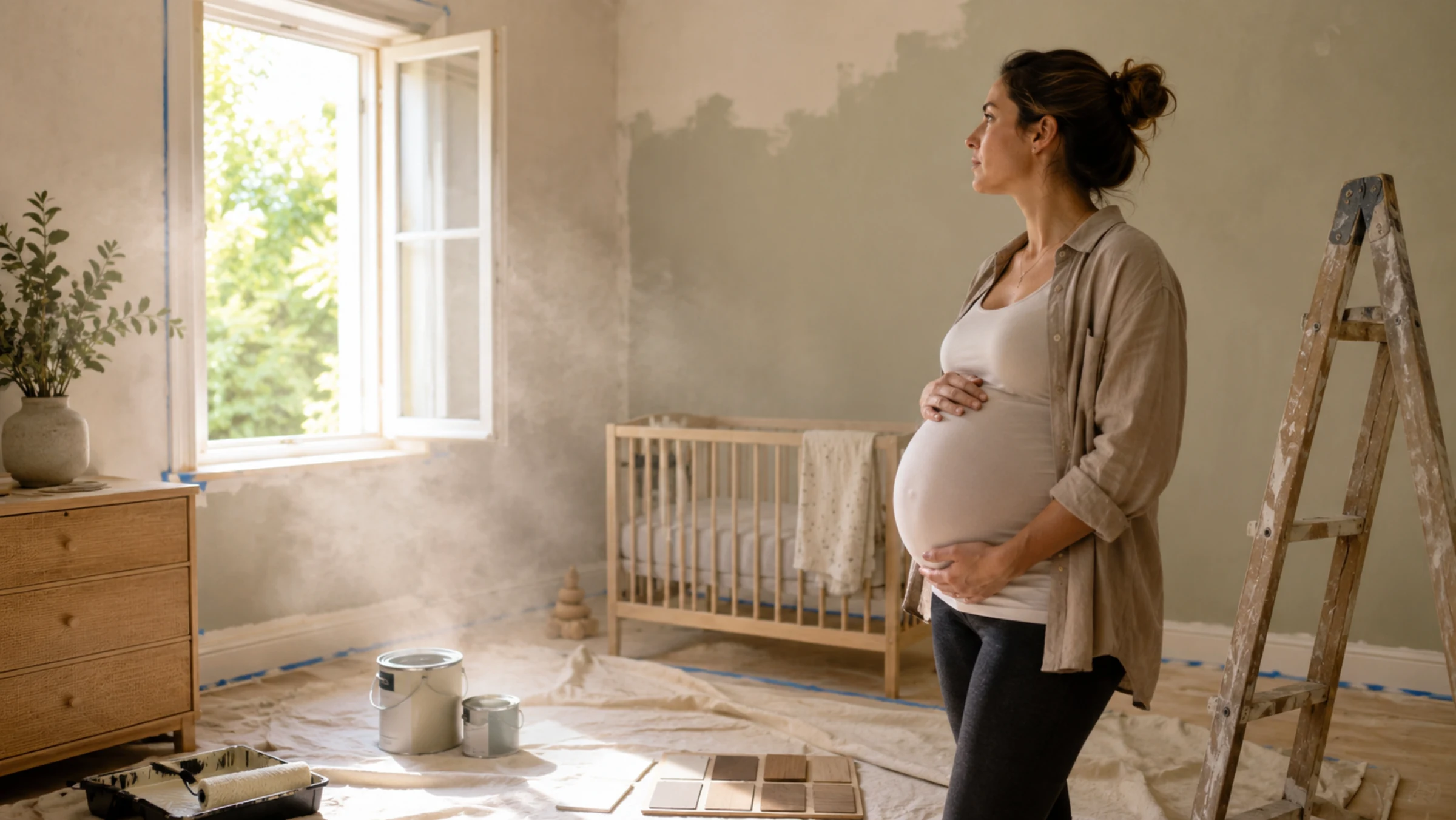
It happens often. A couple buys a home, plans a renovation, and discovers a few weeks in that one of them is pregnant. The project is mid-stream. The question, asked half-anxiously: what’s actually safe?
The honest answer is shorter than the internet would have you believe. Most renovation work is fine to be near, with reasonable distance and ventilation. A small number of activities are genuinely worth avoiding, particularly in the first trimester when fetal organ systems are forming. The rest is mostly common sense.
This is not medical advice. Your obstetrician’s guidance overrides anything below. What follows is the way I plan renovations on projects where the client is, or might be, pregnant.
The genuine risks
Three categories warrant real caution, and the rest can be managed by distance and time.
Lead. If the building is older — pre-1978 in the United States, broadly pre-1960 in much of Europe — assume lead paint somewhere on the original woodwork, windows, or original render. Disturbing it generates fine lead dust, which is the route by which most pregnancy and childhood exposures happen. Lead is a known reproductive and developmental toxicant; the CDC documents no safe blood-lead level in children.
Any sanding, scraping, or demolition on a building of that age should be carried out by an EPA RRP-certified renovator (or local equivalent) using lead-safe practices. The pregnant occupant should be elsewhere during the work and for a full clean-down afterwards.
Solvent-based paints, varnishes, and adhesives. Industrial-strength solvents (xylene, toluene, methylene chloride, traditional oil-based paint thinners) release vapours that have been associated in occupational-exposure studies with adverse reproductive outcomes. The American College of Obstetricians and Gynecologists guidance is straightforward: avoid prolonged exposure to oil-based paints, strippers, and solvent-based adhesives during pregnancy. Water-based, low-VOC paints don’t carry the same evidence base of harm at normal use levels — but ventilate and don’t be the person painting.
Construction dust. The dust of a demolition or major renovation contains silica, lead (in older buildings), asbestos (in some older buildings), formaldehyde from disturbed engineered wood, and mould spores. The pregnant occupant shouldn’t breathe meaningful quantities of it. Sealed-off zones, plastic sheeting, and a non-overlapping schedule between dirty trades and habitation are the standard tools.
By trimester
The first trimester is when fetal organ development happens, and the period when teratogenic exposures (those that affect organ formation) have their largest effect. The bias toward caution is strongest here.
First trimester. No paint, no solvents, no demolition zones. If the renovation involves any of those, the simplest answer is to be elsewhere during them. Stay in another apartment, in a hotel, or at a parent’s house, and return when the work moves out of the dirty phase.
Second trimester. Normal renovation work in adjacent rooms is generally fine with sealed zones and good ventilation. The pregnant occupant should still not be the person painting, sanding, or laying flooring with solvent adhesives. New-furniture off-gassing in a closed room is worth avoiding; ventilate new pieces for several days before they enter the bedroom.
Third trimester. Similar to the second, with additional consideration for sleep and stress. A noisy, dusty job above or next to a third-trimester bedroom is a sleep problem on top of the air-quality one. Plan loud work to finish before week thirty-two if at all possible.
What’s overcautious
Three things that come up in client conversations and that I generally talk people back from worrying about, at reasonable exposures:
- Low-VOC water-based paint applied in another room, with the windows open. The data on this is reassuring at non-occupational doses; the more anxious you are about it, the better-ventilated the room should be, but it does not justify cancelling the project
- Walking through a clean job site for fifteen minutes to check progress. A site that’s been swept and ventilated, between trades, is not a meaningful exposure
- New-build wood furniture that’s been ventilated for two weeks in another room. Most of the off-gassing happens early; airing out before the piece arrives in the bedroom does most of the work
Specific decisions worth front-loading
If you have any choice about timing, the cleanest sequence is:
- Pre-pregnancy or pre-conception: do the dirty work. Stripping, sanding, demolition, lead removal, gas-line work, asbestos abatement if any. None of these are pleasant work to manage during a pregnancy
- Early pregnancy, if mid-renovation: pause demolition and dust-generating work. Continue clean finishing (low-VOC paint by others, with you elsewhere; cabinetry installation; flooring without solvent adhesives) with managed ventilation
- Late pregnancy: complete the room you’ll bring the baby into. Spec the mattress, finish the walls, install the bedside lamps. The room should be done, aired, and quiet by week thirty-six
What I specify on projects with a known pregnancy
- Zero-VOC water-based paint, applied by others, with the occupant out of the building for the day and the night following. Greenguard Gold or equivalent certification on the can
- No solvent-based adhesives anywhere. Wood floors floated or mechanically fixed, not glued, where possible
- Lead test on any pre-1978 (or pre-1960 European) painted surface before sanding or removal. If positive: certified renovator, occupant out
- HEPA-filtered air purifier running in the bedroom for the duration of the project, particularly during finishing trades
- New furniture and mattresses ordered with enough lead time to off-gas in a separate aired room for one to two weeks before being placed
- Cleaning products switched to fragrance-free, plain-soap chemistry. (The spray-bottle article elsewhere in this Journal makes this point in more detail.) This link is a placeholder — replace once the cleaning-products article is published.
The point of caution
There is a particular kind of advice circulating on parenting forums that reads as protective but is actually paralysing — everything is dangerous, every paint is poison, every renovation is a risk. The data doesn’t support that.
The protective version is shorter and more useful: avoid the few things genuinely associated with harm at the doses you might encounter, manage ventilation and distance for the rest, and don’t hold yourself responsible for the entire chemical history of the housing stock you happen to live in.
Then finish the room. Sit in it. Wait.