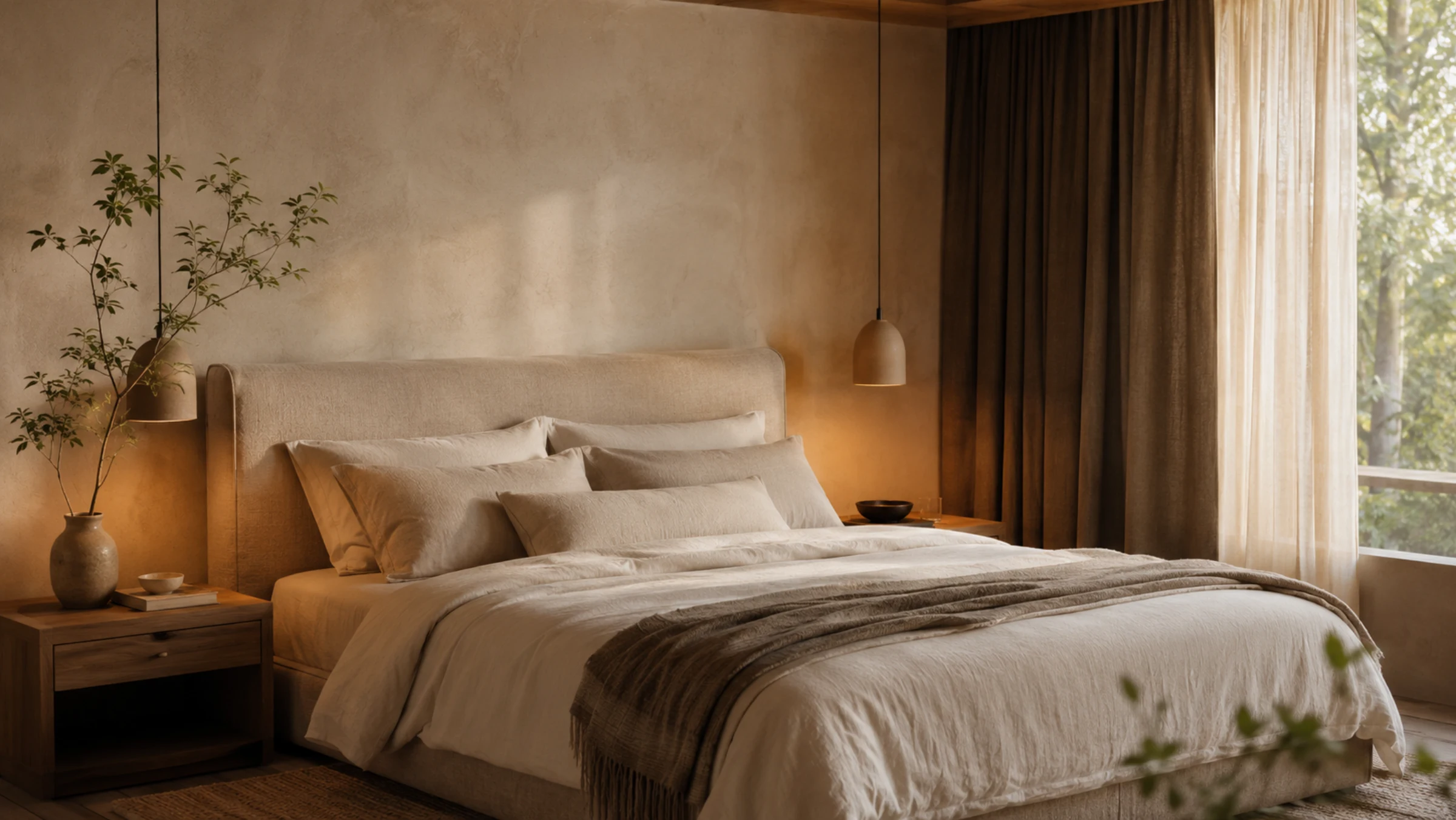
Sleep is a chemical event. You don’t choose to be drowsy any more than you choose to digest. The body either receives the signals it needs to fall asleep, or it doesn’t.
A bedroom is, in that light, not a decorating problem. It’s a piece of equipment designed to deliver those signals to one specific human, over six to eight hours. Most bedrooms fail at this job because they were furnished, not designed.
What the body needs
Decades of sleep research, summarised by the U.S. CDC and the National Sleep Foundation, converge on four environmental requirements:
- Darkness — total or near-total
- Quiet — below roughly thirty decibels of sustained background sound
- Cool temperature — sixteen to nineteen degrees Celsius is the consistent finding
- Fresh air — adequate ventilation, low CO2
Each of these has a design consequence. Most rooms get one or two right and leave the others to chance.
The dark
Even small amounts of light at night suppress melatonin. The body reads ambient brightness through closed eyelids; a streetlight, an LED on a smoke detector, a phone screen face-up on the nightstand — all of them register with the part of the brain that watches for daylight.
For a bedroom this means:
- Blackout curtains or shutters, integrated into the window detail rather than added afterwards
- No visible standby LEDs from the bed. Most rooms have one, somewhere — the router, the diffuser, the smoke alarm. Black tape is a legitimate design move
- A pre-bed routine that doesn’t end on a screen. See the blue light at 10pm
The quiet
The World Health Organization’s Night Noise Guidelines for Europe identify sustained exposure above forty decibels as the threshold at which sleep is materially affected at population scale. Above fifty-five, cardiovascular effects become measurable. Most urban bedrooms run forty to fifty decibels at night even with windows closed, mostly from traffic.
Design moves that help:
- Soft surfaces absorb. Rugs, curtains, upholstered bedheads, fabric panels behind the bed
- A heavy lined curtain across a window can drop interior sound by roughly five decibels — meaningful at the threshold we care about
- Avoid outlet placements that align between rooms; they form an acoustic path through the wall
- For locations where the sound floor can’t be dropped, a low-volume natural-sound machine (rain, wind) helps more than synthetic white noise for most people
The cool
The body sheds heat to fall asleep. A bedroom that holds the body’s temperature against that drop makes the chemistry harder. Sixteen to nineteen degrees Celsius is the consistent recommendation across sleep research.
In practice:
- Heating dropped at night, ideally on a programmable thermostat
- Breathable bedding — linen, cotton, wool — that lets heat escape rather than trapping it
- No polyester sheets or synthetic comforters, especially in summer; they hold heat and skin moisture, which compounds the problem
- Window open when outside air permits, which also addresses the next point
Fresh air
A closed bedroom with two adults accumulates carbon dioxide quickly. Indoor CO2 measurements in occupied bedrooms commonly reach fifteen-hundred to two-thousand parts per million by morning, against the four-hundred parts-per-million baseline outside. Research has documented cognitive impairment and degraded sleep quality at sustained levels above roughly one thousand ppm.
The fix is one window cracked, even in winter, or a designed passive-ventilation pathway. In an apartment without operable windows, a heat-recovery ventilator or balanced mechanical system isn’t optional; it’s the whole air supply.
What I specify
- Blackout shutters or roller shades integrated into the window detail, not added later as a fabric retrofit
- No overhead light. Bedside lamps only, 2700K, dimmable. The room is never lit from above at night
- No standby electronics. A power strip with a switch on the wall, or a dedicated circuit killable from the door, removes all visible LEDs in a single move
- Linen bedding, wool topper, GOLS-certified latex mattress on a solid wood platform — see what’s in your mattress
- Walls in clay plaster where the budget allows. The same finish that regulates humidity also absorbs sound — one decision, two outcomes. See on clay plaster
- An operable window. A bedroom without one is a poorly-built apartment, not a design opportunity
The room behind the door
A bedroom designed for sleep doesn’t look like a magazine spread. It looks like a quiet, slightly under-decorated room. No statement chandelier above the bed, no television across from it, no leather armchair facing the window where no-one will ever sit.
The decorating energy in the room is small. The performance is the whole point.
Open the window. Close the door. The room will do the rest.